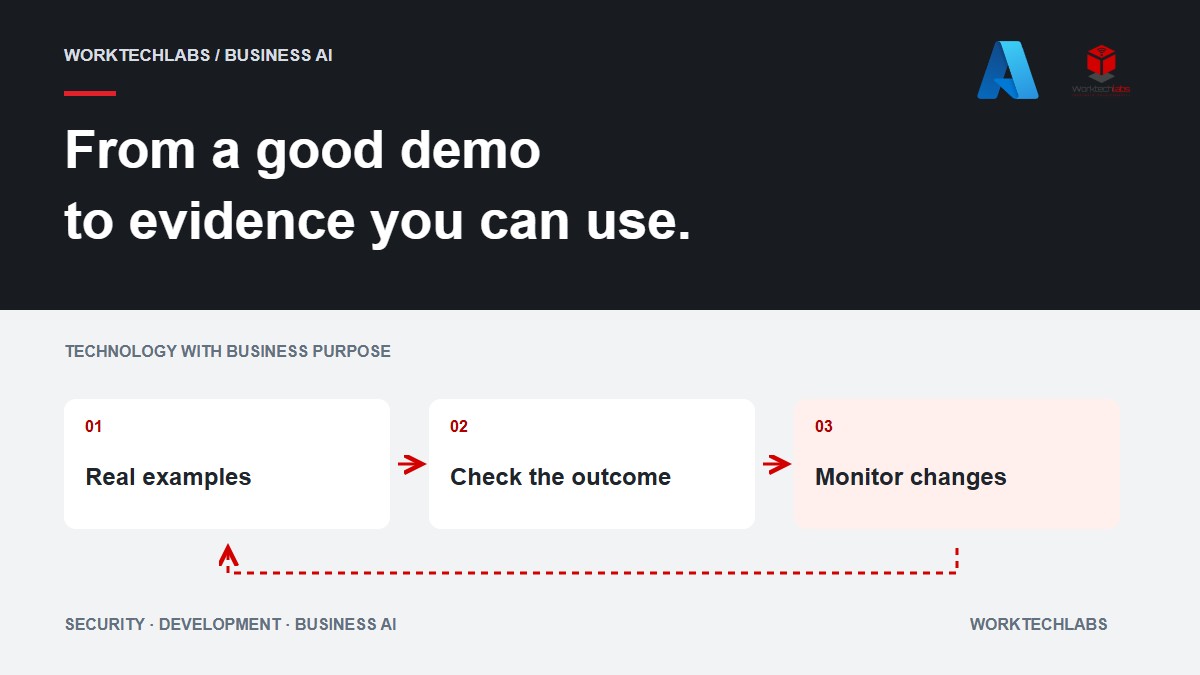
Your team watches an AI agent prepare a convincing answer to a customer enquiry. It retrieves a document, writes clearly and finishes in seconds. The demonstration is encouraging. The production question is different: will it still produce an acceptable result when the document is old, the customer changes the request or one of the connected services fails?
That question has become more practical as agent platforms add evaluation and monitoring capabilities. A business can ask for evidence about task completion, tool use and operating behaviour instead of approving a project from a few impressive examples. The tools help collect that evidence; your company still needs to define what an acceptable result means.
Begin with the business decision the agent supports
Consider an agent that drafts responses to maintenance enquiries. Its job is to prepare a usable draft, identify the relevant equipment and flag information that needs checking. A polished paragraph is only one part of success. The draft may be unacceptable if it refers to the wrong machine or implies that an appointment has already been booked.
Write a short acceptance guide before testing models. State the information that must be present, claims that must be supported and actions that are outside scope. Have a member of the service team apply the guide to sample outputs. If two knowledgeable people disagree repeatedly, clarify the rule before treating an automated score as authoritative.
Keep the guide connected to the real workflow. An internal draft can tolerate visible placeholders that a customer-facing answer cannot. A useful agent may ask for missing information rather than finish every case immediately. Your criteria should reward appropriate uncertainty instead of encouraging confident completion at any cost.
Build a test collection that represents the work
Start with examples from the process the agent will support. Include straightforward requests, incomplete requests, conflicting records, unsupported requests and changes of mind. Capture the relevant context and the expected outcome for each case. Remove information that is unnecessary for the test and control access to the remaining material.
Hold back some examples from day-to-day prompt tuning. If the team repeatedly adjusts the system against the same small set, results can improve without proving that it handles unfamiliar work. Add new examples when staff find a meaningful failure, while retaining earlier cases that protect against regressions.
Separate frequency from severity. A rare incorrect account lookup may matter more than many harmless formatting errors. Report those categories independently. One aggregate percentage can make a system look ready even when it fails the cases that would cause the greatest operational damage.
Understand what current evaluation tools can tell you
Microsoft Foundry documents separate evaluations for the overall task and for the process used to complete it, including tool-related behaviour. Its documentation marks some evaluators as preview. Check each selected capability rather than assuming that every item in an evaluation dashboard has the same release status. See the official agent evaluator reference.
Use an automated score as evidence for review, not as a business sign-off. A model judging another model can miss a specific contractual exception or misunderstand a rule that your operations team considers obvious. Compare the scoring method with human-labelled examples and investigate the disagreements that would alter a release decision.
Where a result can be checked directly, make that check explicit. Confirm that an equipment identifier exists, a required field is populated or a proposed booking is still a draft. These checks make the evaluation more concrete than asking whether an answer generally looks helpful.
Follow the actions as well as the final answer
Suppose two agents produce the same correct paragraph. One reads the authorised service record once. The other searches unrelated accounts, retries repeatedly and eventually reaches the right answer. The visible result hides a significant difference in cost, access and reliability.
Record enough of the execution to investigate that difference: which tool was called, whether it succeeded, how long it took and which business request it belonged to. Avoid turning diagnostic records into an uncontrolled copy of customer data. Decide what can be recorded, who can inspect it and how long it should remain available.
For the maintenance example, the reviewer should be able to tell whether the agent consulted the current equipment record or an outdated document. This is also useful when a customer disputes an answer. Staff can investigate the evidence behind the response rather than trying to reconstruct a conversation from memory.
Set release conditions that your team can act on
A release review should combine quality, permissions, cost and response time. Define a small set of blocking failures, such as accessing another customer's record or claiming that a booking exists when it does not. Decide how lesser issues will be recorded and whether the remaining review workload is acceptable.
Run the agreed collection after changes to the model, instructions, tools or source material. A model upgrade is one reason for behaviour to change, but an updated connector or a reorganised knowledge library can be just as important. Keep enough version information to connect a result to the configuration that produced it.
Before broad release, use a limited pilot where staff can compare the agent's drafts with normal work. Do not quietly expose unreviewed experimental responses to all customers. The pilot should have an owner, a review period and a clear decision about expanding, revising or stopping the capability.
Monitor the work after the launch
Production introduces cases the initial collection did not contain. Sample outcomes, review customer corrections and watch for changes in transfer rates, failed tool calls and repeated attempts. An increase in unresolved requests may reveal a problem even when every infrastructure health check is green.
Connect alerts to someone who can act. Decide which issues require disabling one tool, routing a task to a person or reverting a configuration. A dashboard without an operational response leaves the team informed but unable to protect the service.
Budget for evaluation itself. Microsoft notes that model-based evaluation can consume quota for the judging model. The business should include that work in the operating plan instead of treating it as a one-time launch expense. See running evaluations in Foundry.
What to ask for in an AI proposal
Ask a supplier to show the test collection, acceptance guide, failure categories and review process. Request examples of unsuccessful runs as well as successful ones. Discuss who will add new cases, investigate regressions and approve a change once the initial project has ended.
Worktechlabs can help define that evidence around a focused business AI integration, with application checks and a practical route into ongoing support. Bring a real task, representative inputs and the person who can judge the result. A useful first milestone is a repeatable comparison that tells your company whether the proposed system is ready for the next level of responsibility.
Product documentation checked on 7 October 2026. Preview status and supported evaluation options should be reconfirmed when selecting the implementation.