
A customer asks whether a replacement part will arrive before an engineer's visit. Your virtual assistant finds the shipping policy and gives a friendly answer. The policy is correct, but the answer is useless: this particular order is waiting for a stock transfer. Someone still needs to investigate, contact the customer and decide whether to move the appointment.
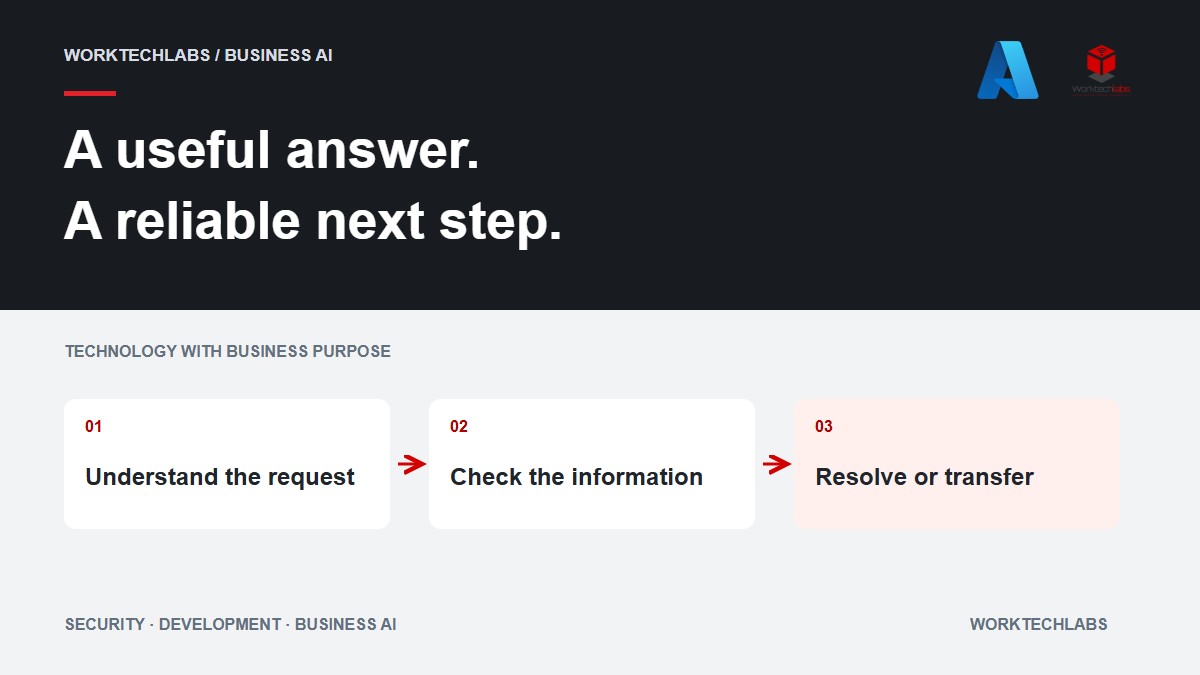
This is where a business discovers what it actually bought. A chat window can produce responses. A useful service agent must help a customer reach a reliable next step, including the moment a person needs to take over. The difference affects repeat enquiries, staff workload and the confidence customers place in your company.
Choose a customer task that has an ending
Start with a question your team already understands. Tracking a service request, explaining a published returns process or collecting information for an appointment can be reasonable candidates. Each has a recognisable outcome and a team that can check whether the answer helped.
Write that outcome as a short sentence: the customer knows the current request status and who will act next. Avoid defining success as the customer having a conversation. A long exchange can mean the customer is struggling. Similarly, a closed chat does not prove a problem was resolved; the customer may simply have given up.
Choose the first task using a sample of real enquiries. Include ordinary cases and awkward ones: missing references, ambiguous product names, two orders under the same email address and requests sent outside working hours. Remove unnecessary personal information before using examples for development. Ask the staff who normally handle these enquiries to describe a satisfactory ending.
Separate public information from account information
An opening-hours answer can use public information. An answer about a particular invoice requires an appropriate customer identity and permission to see that invoice. Knowing an order number is not automatically sufficient proof of access. Design the account check before connecting the agent to operational systems.
A practical first release might answer general questions anonymously, then offer a secure sign-in for account-specific requests. The application should enforce that boundary. A sentence in the agent's instructions asking it to respect privacy cannot substitute for an access check in the service returning the data.
Also define which system owns each answer. The website may own standard delivery guidance; the ERP may own stock allocation; the service system may own appointment status. When two sources disagree, the agent needs a defined response and an escalation route. It should not invent a compromise between two incompatible records.
Make transfer to a person part of the product
Microsoft documents a Copilot Studio integration that can transfer a conversation and collected information to Dynamics 365 Customer Service. That capability is useful, but its configuration and licensing requirements still need checking for the proposed environment. A connector does not establish your staffing arrangements or your service promise. See the official handoff documentation.
For your own workflow, specify the transfer triggers. Examples include a disputed charge, a request outside the permitted action list, conflicting source information or a customer explicitly asking for a person. Give customers an understandable route to that person without making them fail a series of conversational tests first.
The receiving colleague should get a useful brief: the customer's confirmed identity, the problem, information already checked, steps already attempted and any remaining uncertainty. A transcript alone can make the employee repeat the customer's work. Keep the brief factual and allow access to the original exchange when the summary needs verification.
Say what happens when nobody is available
An assistant available at midnight does not mean a staffed support team is available at midnight. Explain when a human can respond and what the customer can do meanwhile. If the agent creates a request, return a reference only after the service system confirms that creation.
Think through failed transfers. The queue might be unavailable, a connection might time out or the receiving team might be closed. The customer needs an honest status and another usable channel. Repeatedly saying that somebody will join shortly can turn a manageable delay into a broken promise.
For the replacement-part example, a sensible outcome could be a recorded investigation request with the appointment reference attached. The assistant can explain the known stock status and the support hours. It should not promise an arrival date that nobody has verified or cancel an appointment without the required authority.
Measure resolution and the work left behind
Build a small dashboard around the task. Count completed customer outcomes, transfers that reached the correct queue, repeat contacts about the same issue and the time staff spend repairing inaccurate summaries. Read a sample of conversations alongside the numbers. A rising containment rate may conceal customers who could not reach help.
Compare the pilot with a similar period or group using the existing process. Keep the comparison honest about changes in demand, staffing or case complexity. If the agent handles simple enquiries while people inherit every difficult case, average human handling time may rise even when the overall service improves.
Review language quality separately. A bilingual assistant should preserve reference numbers, dates, product names and commitments across English and Spanish. Test a customer switching languages midway through the conversation. The agent should retain the task context and continue to respect the same access and approval boundaries.
Run a small, reversible pilot
Begin with a limited set of questions and a defined customer group. Keep a visible way to reach the established service channel. Give an employee responsibility for reviewing failed conversations, correcting source material and deciding whether the agent should remain available for each task.
Before expanding, rehearse three situations: the operational system is unavailable, the customer requests information belonging to another account, and the answer requires a decision outside the agent's authority. A good pilot demonstrates how the service behaves under those conditions, not only how attractive a successful conversation looks.
Set an explicit expansion decision. For example, the team may require satisfactory outcomes on agreed test cases, reliable transfers and an acceptable review workload. Those are your project criteria, not universal guarantees. Write down what evidence would make you pause the rollout and who can disable the affected capability.
Where Worktechlabs can help
Worktechlabs can help map the customer journey, connect the relevant business systems and build the application controls around an AI integration. We can also review how the new channel fits your customer portal and existing support process.
Bring a representative set of enquiries, the systems used to answer them and the team's current escalation rules. A useful first engagement can produce a bounded pilot, a test set and a clear handover design. The result you should seek is a customer who reaches the next step with less effort, and a support team that can see exactly what remains to be done.
Editorial sources checked on 7 October 2026. Product availability and licensing should be confirmed for the selected environment before implementation.