
A sales team has agreed a deal. The customer is ready to sign. Then the quote portal rejects the order because the customer's company name contains a character nobody anticipated.
In this illustrative scenario, the salesperson creates a support ticket, the developer asks for an example, and somebody searches for the rules behind an old validation. The fix might be small. The delay comes from everything around it.
Now imagine that an assistant assembles the relevant evidence, proposes a focused change and runs the checks needed for a reviewer to make a decision. The customer still needs a working quote. Your team gets a shorter route to delivering it.
That is the business opportunity behind AI assisted software delivery: moving a useful improvement through the whole process, with enough evidence to trust the result. At Worktechlabs, we believe the starting point should be the delivery problem your business needs to solve.
What the software factory story actually tells us
OpenAI describes Symphony as an orchestrator connecting work items with coding agents. It reports 500% more merged pull requests in some teams during their first three weeks. That is a scoped observation, not a forecast for your business. Read OpenAI's account.
The official Symphony repository describes an engineering preview intended for trusted environments. An experiment with that tool needs its own assessment before production use.
For a business owner, a pull request is a proposed code change. Counting more of them does not tell you whether customers can complete orders, whether the support queue is shrinking or whether maintenance is becoming easier. Those are the outcomes worth commissioning.
Begin with the time your customers lose
Before choosing agents, map one recurring delay. Perhaps a salesperson waits for a quote correction, an operations colleague copies data between two systems, or a developer spends half a day reconstructing an incident.
Write down who requests the change, what information is missing, who checks it and how it reaches users. Include waiting time. The biggest opportunity may be clearer requirements or a repeatable deployment rather than faster typing.
For the quote example, a useful objective is to reduce the elapsed time from a reproducible issue to a verified correction. Record how long that takes today and how much staff involvement it needs. Keep the customer outcome visible alongside the engineering measure.
This gives the project a boundary. You can evaluate one improvement without signing up to automate the entire development department.
Give the assistant a small, reliable working context
An assistant needs the rules relevant to its task: accepted company name formats, examples of rejected input, the affected integration and the expected behaviour. An approved, anonymised example can be more useful than access to years of company messages.
Treat a support ticket as information to investigate. It should not be able to grant permissions or redefine the release process. Keep access limited to the project and distinguish customer supplied text from instructions authorised by the team.
In a legacy application, useful rules may exist only in people's memories. Capture those decisions and identify their owner before automating changes. This work also makes onboarding, support and future supplier handovers easier.
Define evidence before asking for code
The assignment should describe what a successful correction looks like. For the quote portal, include a permitted company name that currently fails, an ordinary name that must keep working and malformed input that must still be rejected.
Ask for a small change, an explanation of its scope and proof that the relevant behaviour works. A plausible explanation from the assistant is not a substitute for running the application against those examples.
Keep business rules under the same scrutiny as technical correctness. A fix that accepts the name but silently changes a tax identifier has failed the task. Someone familiar with the process should decide whether the examples cover the intended outcome.
Where existing .NET applications need improvement, the first deliverable can therefore be an agreed set of behaviours. That is a stronger basis for a proposal than an instruction to make the system more intelligent.
Set release authority outside the agent
Your team should define which changes can progress automatically and which require a named reviewer. Permissions, payments, data deletion and changes shared across customers deserve particular attention. The decision should consider impact, reversibility and the strength of the evidence.
An agent can help identify concerns. It should not be able to rewrite the policy that limits its own access or approve an exception merely because its explanation sounds convincing.
Build and deployment checks give these decisions a repeatable structure. Microsoft's guidance recommends small releases, progressive exposure and health checks. Those controls remain useful when an assistant writes the code. See Azure's safe deployment guidance.
Specify what recovery means for the particular change. Reverting an application version may leave new database records or messages already sent to another system. Decide how those effects will be handled before release.
Check whether the business process improved
After the quote fix, can the customer complete the order? Does it still reach the ERP correctly? Has anyone started correcting a new problem by hand? These questions connect technical monitoring with the reason for doing the work.
Agree a review period that includes representative usage. Compare failed quote submissions, completion time and support requests against the previous baseline. Look for side effects as well as the intended improvement.
Give a named person responsibility for investigating unexpected results. Otherwise, an automated alert simply creates another queue that nobody owns. The operating plan should say who can stop a rollout, who communicates with the business and who checks that recovery worked.
Put the whole operating cost in the decision
The model bill is one part of the cost. Include setup, integration, execution environments, repeated attempts, human review and maintenance of the automation itself. A low cost attempt can become expensive when the task repeatedly fails.
For a pilot, define a spending limit, a maximum number of retries and a point at which the work returns to a person. Track cost per accepted improvement alongside time saved. If reviewing a change takes longer than doing it conventionally, investigate why before increasing the volume.
Hosted and local models both deserve evaluation against the actual task. Local operation still needs infrastructure and people to run it. A hosted service still needs suitable data handling, access controls and an affordable usage pattern. Neither option proves the business case by itself.
A practical first engagement with Worktechlabs
We can help assess your application's code and architecture, clarify an improvement in an existing workflow and plan the AI integration around its business purpose. The appropriate starting point depends on the condition of the system and the evidence already available.
Bring one recurring problem, a description of the application and examples of what should happen. Identify the integrations involved and the person who can confirm the business rules. Start with a description; access requirements and the review scope can be agreed afterwards.
A useful initial scope can cover the current bottleneck, missing checks, an appropriate pilot and the responsibilities needed to maintain it. Where basic deployment or integration work is the priority, that should be visible in the proposal too.
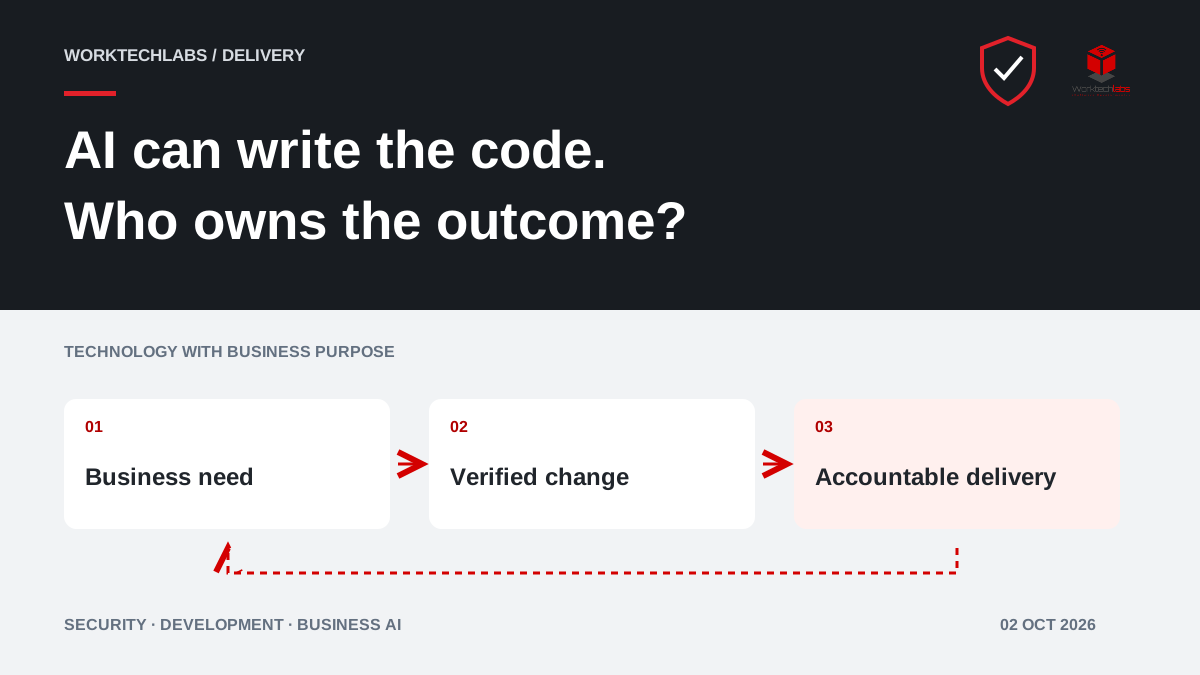
The quote scenario illustrates the intended outcome: a customer can proceed, staff spend less time coordinating a correction, and somebody remains accountable for the system. The value comes from completing that loop.
Turn the idea into a scoped next step
Your business does not need to decide today how autonomous software development might eventually become. It needs to know which improvement is worth making next, what would demonstrate success and who will support the result.
Have an application that takes too long to change? Request a code review from Worktechlabs. Tell us where delivery gets stuck so we can discuss the scope and provide a proposal suited to your system.
This article presents Worktechlabs' proposed approach to assessing a project. The quote portal is an illustrative example, not a reported customer result. Sources were checked on 2 October 2026.