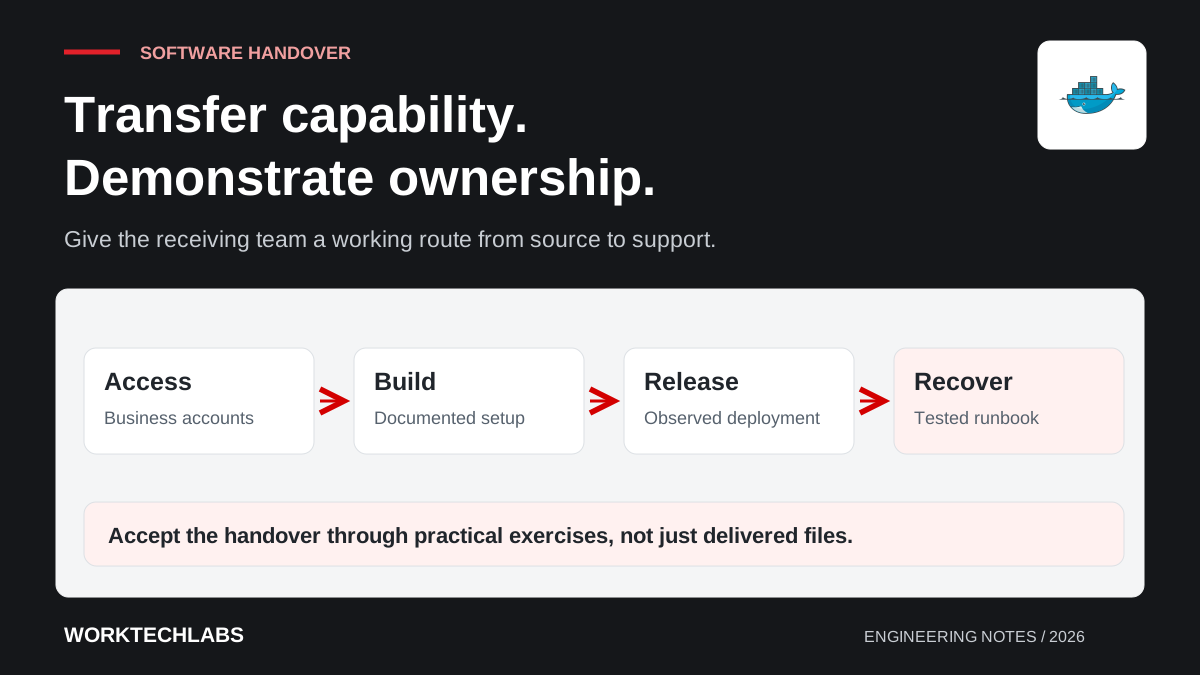
A software handover is not complete when a repository is shared and a folder of documents is delivered. The receiving team must be able to make a change, release it, investigate a problem and recover the application using the accounts and information available to them. Until those capabilities are demonstrated, the business may still depend on the outgoing supplier.
The most effective handovers are designed as a series of practical exercises. Documentation supports the work, but the exercises establish whether it is sufficient. This approach also gives both teams a clear way to identify missing information before an urgent production issue makes the gap expensive.
Define what responsibility is transferring
List the applications, environments, integrations and support duties included in the transfer. Record what the receiving team will own and what remains with another supplier or internal department. Shared responsibilities need explicit boundaries so an incident does not become a discussion about whose contract contains the missing task.
Agree the acceptance evidence for the handover. Useful examples include a successful local build, a deployment to a test environment, an observed recovery exercise and access to the relevant operational records. The exact exercises should reflect the product rather than a generic checklist copied from another project.
Set a transition period with named contacts and a process for unresolved questions. Some gaps appear only when the new team performs real work. A visible list of open items is more useful than an early declaration that everything has been transferred because the documentation deadline has arrived.
Inventory the accounts that keep the product running
Record ownership and administrative access for source repositories, cloud subscriptions, domains, certificates, package feeds, monitoring and external services. Include build identities and automated jobs. An application can appear fully transferred while its next deployment still depends on a private package feed controlled by the outgoing team.
Use business-controlled accounts and appropriate roles where the operating model requires them. Verify access through the normal authentication process rather than distributing credentials in a shared document. Record how access is recovered and who authorises changes.
Plan the removal or reduction of outgoing access after the receiving team has verified its capability. Coordinate credential rotation and integration changes so the transfer does not accidentally stop working services. Treat each dependency as an operational change with an owner and a check, rather than as a single administrative cleanup step.
Build from the supplied instructions
Ask a receiving engineer to create a development environment from the documented starting point. They should be able to identify the required runtime, obtain dependencies, configure a suitable database and run the application. Record every additional instruction supplied during the exercise.
Use appropriate development data and secret-management arrangements. A handover should not depend on sending an unrestricted production database to every new developer. Document how representative data is prepared and which external integrations are replaced or limited during local work.
Resolve discrepancies between the repository and the live system. Identify the deployed source revision and any changes that exist only in an environment. A reproducible build gives the team a baseline from which later changes can be explained and reviewed.
Transfer the map of important business rules
Explain the workflows that are most consequential or least obvious from the screens. Include approval rules, calculations, state transitions and exceptions handled by scheduled processes. Link the explanation to representative examples and the code or tests that implement it.
For a hypothetical quoting system, the receiving team should know how discounts interact with approval limits and what happens when an accepted quote changes. A sequence diagram or worked example can communicate more than a broad description saying that the application contains a pricing module.
Identify unusual decisions and their reasons. Some apparent complexity may preserve a contractual requirement or accommodate an unreliable supplier. Other complexity may be obsolete. Distinguishing those cases helps the new team avoid removing behaviour that still matters or preserving workarounds indefinitely without understanding them.
Rehearse release and incident handling
Have the receiving team deploy an identifiable version to a suitable environment and verify a meaningful journey. They should understand configuration inputs, database changes, approval steps and recovery choices. The outgoing team can observe, but every intervention should become an explicit handover item.
Next, walk through a realistic incident using the actual dashboards, logs and runbooks. Ask the receiving team to locate the application version, trace a failed operation and explain the first recovery action. Google's discussion of production readiness and SRE engagement illustrates why operational understanding matters when responsibility changes, although a small business can use a much lighter process.
Include the communication route. The team needs to know who informs users, who can approve a disruptive recovery action and which suppliers must be contacted. Technical access is only part of the ability to manage an incident effectively.
Make maintenance and known limitations visible
Provide the current dependency inventory, update process and outstanding technical work. Distinguish a verified defect from a possible concern, and record the circumstances under which each issue matters. A backlog with no evidence or priority can leave the receiving team uncertain where to begin.
Include recurring manual tasks and their frequency. Examples might be correcting an import, renewing a certificate or reviewing failed background jobs. Estimate the operating effort so the business understands the support capacity required after transfer.
Record important limits: tested data volumes, integration rate constraints and workflows that cannot be reversed automatically. These details support realistic planning. Handover should give the new team an accurate operating picture, including what remains uncertain, rather than an idealised description of the product.
Accept the handover through demonstrated capability
Review the agreed exercises and unresolved items together. Confirm that the receiving team can access the required systems, make a controlled change and respond to the important failure scenarios. Assign owners and dates to any remaining work that does not prevent the transfer.
Keep the final handover pack concise and navigable. It should link to maintained sources of truth rather than duplicate information across documents that will quickly diverge. Make updating those sources part of normal delivery after the transition.
Worktechlabs supports technical documentation and supplier handovers, as well as ongoing application maintenance. A successful transfer leaves the business with a team that can demonstrate ownership in practice, not merely a collection of files and an assumption that someone else knows how they fit together.