
An automation proposal often begins with an attractive calculation: a task takes several minutes, it happens many times, and software could remove most of the effort. That is useful starting information, but it is not yet a complete business case. The business must understand what changes, what it costs to operate and how the released capacity will produce a useful outcome.
A credible case helps you choose a manageable first project and decide whether to continue after the pilot. It should make uncertainty visible rather than hide it behind a precise-looking return figure.
Define the problem in operational terms
Describe the current process, the people involved and the consequence of the problem. “Automate administration” is too broad. “Reduce repeated entry of accepted orders so the team can prepare work sooner” connects the activity to a business result that can be observed.
Establish what is included and excluded. An integration that creates an order may still require someone to review unusual terms. A document assistant may prepare a draft without replacing the final decision. Stating these boundaries prevents the case from counting work as removed when the proposed solution only changes how it is performed.
Build a baseline from a representative sample
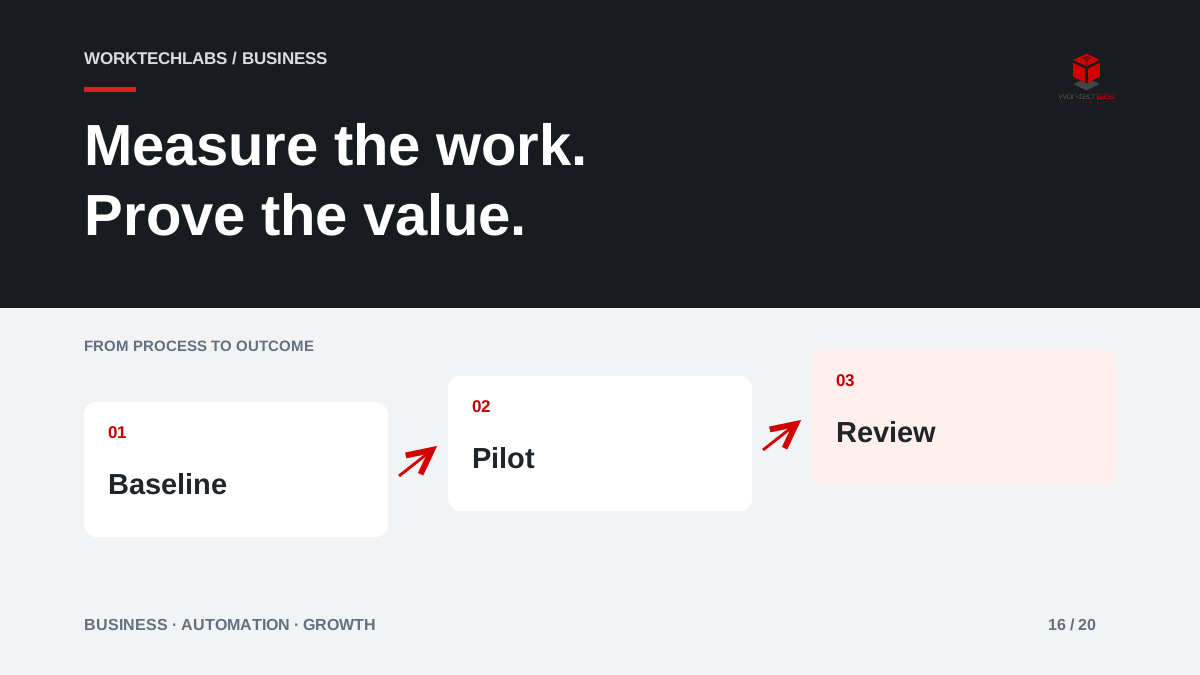
Observe several examples across normal and busy periods. Record volume, active work, waiting, corrections and exceptions. Ask staff to show the task rather than estimate every step from memory. A memorable difficult case can make the average look worse, while a demonstration under ideal conditions can make it look unrealistically simple.
Keep the measurement method practical. You do not need to monitor every keystroke to understand a repeated handover problem. A small, clearly described sample is often more useful than a large estimate whose origin nobody can explain. Record what the sample may not represent so the pilot can test those uncertainties.
Separate capacity, expenditure and commercial outcomes
Time released is capacity that the business can use. It becomes a cash saving only when expenditure actually changes, and it becomes revenue only when useful additional work is sold and delivered. Treat these as different possible outcomes rather than adding them together automatically.
For example, an illustrative team might recover time previously spent re-entering orders and use it to respond more carefully to complex customers. That can be valuable even if staffing costs remain unchanged. Describe the intended use and assign someone to confirm whether it happens. Otherwise, the claimed benefit remains theoretical after the software is delivered.
Include the work required to keep it running
Estimate implementation, integration, data preparation, internal participation, training and ongoing support. Consider licence or usage costs where relevant, and identify who will maintain connections when the surrounding applications change. A workflow that depends on one employee's personal account creates an operational responsibility that the business case should address.
Include exception handling. If automation processes routine cases but staff still resolve difficult ones, estimate that remaining work and the tools needed to do it. A design that saves time on normal cases while making failures hard to investigate can consume its expected benefit in support effort.
Compare credible options
Include the option of simplifying the process before automating it. Removing an unnecessary approval or collecting information earlier may solve part of the problem at lower cost. Compare configuration of existing tools, a focused integration and a broader application change against the same desired outcome.
Microsoft's guidance on measuring Power Platform business value and assessing automation impact offers references for connecting implementation to outcomes. Use those ideas to structure your own evidence, while keeping the calculations specific to your volumes, costs and constraints. Vendor examples are not a forecast for your company.
Use a pilot to test the uncertain assumptions
Choose a bounded workflow with enough real activity to evaluate it. Agree what would demonstrate improvement and what would justify stopping or redesigning. Measure the whole process, including preparation and exceptions, so the pilot cannot appear successful merely by moving work to another team.
Compare like-for-like cases and note changes in workload, staffing or customer mix. Review qualitative evidence too: whether employees trust the result, whether customers understand the next step and whether support can recover a failed case. A sensible decision combines operational measures with evidence about usability and maintainability.
Make the decision reviewable
Present the problem, baseline, options, expected outcomes, costs and main uncertainties in a concise document. Distinguish observed facts from estimates. Name the business owner who will review results after launch and decide how the process changes if the expected benefit does not appear.
Worktechlabs can help investigate a workflow and turn it into a concrete automation project with a measurable first scope. Share the task you are considering automating. We can help identify what evidence to collect, which assumptions deserve a pilot and how to judge whether the change creates useful capacity for your business.
Official sources and further reading