
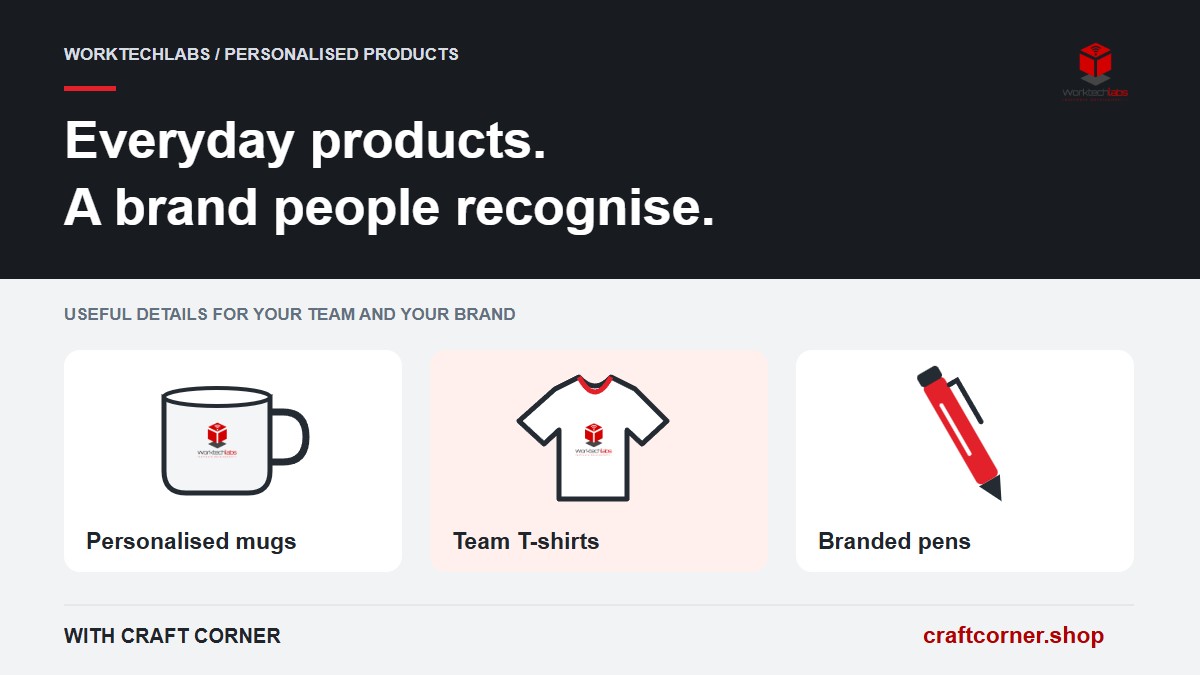
A mug on a desk, a T-shirt worn at an event and a pen handed to a customer are small parts of a company's day. They are also physical expressions of its identity. When those details are useful, well considered and consistent, they help the business present itself with the same care it puts into its website, proposals and customer service.
At Worktechlabs, Craft Corner makes personalised mugs, T-shirts and pens for us. That practical relationship is why we want to highlight the value of having a supplier for this part of the business. You can explore Craft Corner's shop and discuss a particular project with their team. The wider lesson is that everyday branded products deserve a little planning, rather than becoming a last-minute task whenever someone needs something.
Everyday products help make a brand recognisable
A company's identity does not stop at its logo file. People encounter it in meeting rooms, at a reception desk, during a site visit and when joining a team. A mug or a shirt can connect those experiences visually, especially when its colours and artwork reflect the materials customers already recognise.
Consistency matters more than putting a large logo on every available surface. A design that works on a website header may need adjusting for a narrow pen or a curved mug. Small lettering, fine lines and an unsuitable background can make an otherwise good design difficult to read. The objective is a clear, usable result that suits the product.
Think about the setting as well. A discreet design may be appropriate for everyday office use, while an event shirt needs to help visitors recognise the team. A supplier who understands the intended use can discuss those choices before production. That conversation is part of the value of the relationship, alongside the item itself.
Choose things people will actually use
Start with the recipient and the task. A mug might belong in an employee welcome pack, a pen on a meeting table and a T-shirt in a team event kit. Each has a practical purpose. Choosing an item because it is useful gives the branding somewhere natural to live.
For clothing, ask the team about sizes and fit before ordering. For desk items, consider available space and how people work, including colleagues based at home. A uniform pack is convenient to organise, but a small choice can prevent items being left unused. Personalisation should make the product more relevant to its recipient.
Customer gifts need the same thought. A useful item can accompany a meeting or a thank-you, but it cannot substitute for delivering good work. Choose something proportionate to the relationship and the occasion. There is no need to attach a sales claim to every object: sometimes a practical, well-presented gesture is enough.
A regular supplier reduces repeated administration
Buying each item from a different place means repeating the same explanations: which logo is current, where the artwork should sit, what colour to use and who approves the proof. Over time, that fragmented process can leave several versions of the brand circulating around the business.
A regular supplier gives you an opportunity to establish an agreed reference. Keep the approved artwork, product details, print placement and previous order information together. Confirm what the supplier can retain for future orders, and maintain your own copy. The next request can then begin with a known specification instead of an old photograph found in a message thread.
Centralising the conversation can also make changes easier to coordinate. If the logo changes, the person responsible for the brand can update the reference before another department orders more stock. This does not require a complicated purchasing system. A named owner and a clear record are often enough for a small team.
Approve the detail before ordering the quantity
Look beyond the artwork preview. Check the product's size, material, finish and care instructions, and ask about a physical sample when the order justifies it. For mugs, consider everyday handling and cleaning; for shirts, fit and washing; for pens, comfort and writing quality. These are questions to resolve for the chosen product, not assumptions that a logo alone can answer.
Craft Corner's personalised business logo sticker page describes sending artwork and approving a mock-up. That is a useful example of making the design decision visible before production. For other products, ask which proof or sample process applies to the particular order.
Appoint one person to approve the final version. They should check names, spelling, contact details, colours and placement, along with the agreed quantities and sizes. Save that approval with the order. Clear sign-off helps both buyer and supplier understand what was requested if a question arises later.
Plan welcome packs and events as complete deliveries
Imagine a small business preparing for four new colleagues and a customer event. A practical order might include named mugs for the new starters, shirts in confirmed sizes for the event team and pens for the meeting table.
Work backwards from when the items must be ready to use. Allow for artwork approval, production, delivery and checking the contents on arrival. Ask the supplier to confirm the timetable for your order rather than assuming the dispatch date is the same as the date everything will be available at the event.
For a welcome pack, make the handover personal. Check the person's name, arrange delivery to the correct location and explain the practical information they need alongside the gift. For an event, identify who receives the boxes and who brings them to the venue. A thoughtful product loses some of its usefulness if nobody knows where it is when needed.
Keep replenishment and spending understandable
Once the first order is complete, record what was actually used. Separate stock reserved for an event from items available for everyday needs. A small minimum-stock reminder can help prevent an urgent order, while a review of slow-moving items can stop the business repeatedly buying things nobody chooses.
Compare the whole order cost: the products, personalisation, any setup work, delivery and applicable taxes. Ask whether a later small repeat order uses the same terms. A low unit price on a large batch is only useful if the business needs that quantity and has somewhere sensible to keep it.
Avoid treating merchandise as a guaranteed customer-acquisition strategy. If it supports an event, assess the event through useful conversations and appropriate follow-up. If it supports onboarding, ask whether the recipients found the items useful. Those observations give you a stronger basis for the next order than simply counting how many objects carried the logo.
Give your supplier a brief they can act on
A short, complete brief saves questions later. Include the intended use, product ideas, quantities, required date, delivery location and the person who can approve the design. Supply the artwork in the format requested and identify any brand details that must remain consistent. For personalised names or clothing sizes, send a checked list through the agreed channel.
Ask about current availability, minimum quantities, proofing, lead times and the process for reporting a damaged or incorrect item. If matching an earlier order matters, provide its reference and ask whether the same product and finish remain available. A good working relationship includes confirming changes rather than assuming every future batch will be identical.
Worktechlabs helps businesses organise operational processes and ERP systems and connect information through business integrations. The same principle applies here on a smaller scale: clear requests, approvals and records make repeated work easier. As purchasing grows, those records can become part of a wider workflow without losing the direct relationship with the supplier.
Why we are giving Craft Corner a mention
Craft Corner is part of how we put our own brand onto everyday products. We value the practical role of having a place to discuss personalised mugs, T-shirts, pens and the details of a specific request. This article is a recommendation to give that part of your business the attention it deserves, whether you are organising a small welcome pack or preparing materials for a team occasion.
If you are considering personalised products for your office, visit Craft Corner and contact their team with your idea. Explain who the items are for, what you need and when you need them. That is a useful starting point for choosing products that represent your company and become part of people's working day.
Supplier links