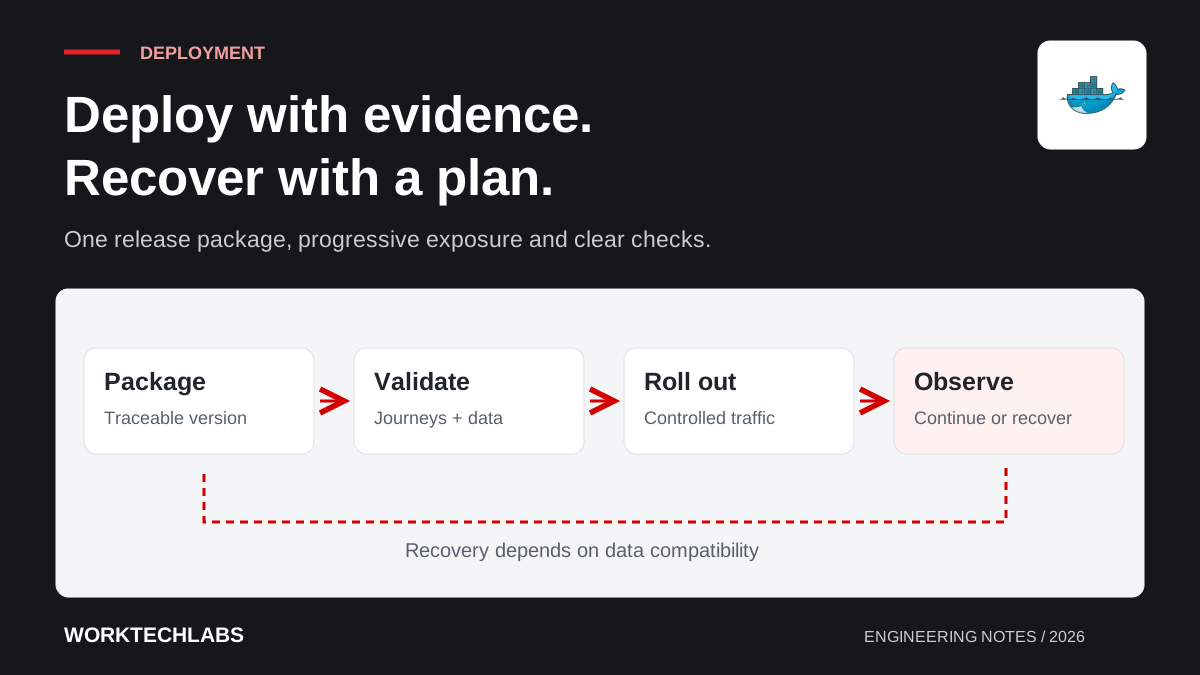
A deployment becomes stressful when too many things must be remembered at the same time. Someone copies files, someone changes configuration, another person updates the database, and the team waits for a customer to report whether it worked. Even excellent engineers find this difficult to repeat consistently under pressure.
Predictable deployment starts with a different definition of success. The application must be running the intended version, its important workflows must behave correctly, and the team must know what to do if they do not. A green pipeline is evidence that a process finished. It is only one part of the evidence needed to trust a release.
Separate deployment from releasing a feature
Deployment installs a version into an environment. Release makes a capability available to its intended users. Keeping these decisions separate can reduce the number of unknowns in a change. A team might deploy a new quotation workflow behind a feature flag, check it with internal users and then make it available to a selected customer group.
Feature flags need owners and removal dates. Each flag creates another possible application state, and combinations become harder to test as flags accumulate. Record what happens when the flag is off, which roles can change it and whether switching it off reverses any work already performed. Hiding a screen does not undo records that the feature has written.
A useful release record connects the application version, configuration, database changes and feature settings. When an incident occurs, the team can establish what changed without interviewing everyone who was online that afternoon.
Build one identifiable artefact
Create the deployable package once, identify it clearly and promote that same package through the environments used to approve it. For a container, record the image digest. For an application package, retain its version and source revision. Rebuilding separately for production introduces another change after the team has finished testing.
Keep environment settings outside the package and validate them before deployment. A staging database address in production is a configuration failure even when the binary is correct. Validate required settings, identity permissions and dependency access without exposing secrets in build logs. Distinguish a missing configuration value from an unavailable dependency so the operator receives a useful error.
The package should also have an owner and a retention policy. During a recovery, finding the previous approved version should be a routine lookup. It should not depend on an engineer still having yesterday's output directory on a laptop.
Match the deployment strategy to the application
A rolling deployment replaces instances gradually. It can preserve capacity, but old and new versions overlap, so their behaviour must remain compatible. A blue-green approach prepares a separate version and switches traffic between environments. A canary exposes a smaller audience first so the team can observe the change before expanding it.
These approaches answer different questions about capacity, traffic control and recovery. Microsoft's safe deployment guidance recommends progressive exposure with health checks between stages. The practical lesson is to make each expansion conditional on evidence instead of moving forward simply because a timer expired.
For a small internal application, a planned maintenance window may still be the clearest option. The important choice is an approach that the team can implement and rehearse. Adding complex traffic management without understanding sessions, background workers and database compatibility can create more uncertainty than it removes.
Treat database changes as a separate design problem
Application versions can often be switched quickly. Data changes are harder to reverse because users continue creating valuable records. A release plan therefore needs to explain how the old and new versions interact with the database during transition.
An expand-and-contract sequence can help. Add a new nullable field or structure first, deploy code that works with the transition state, backfill existing records carefully, and remove the old structure only after its consumers have gone. The exact sequence depends on the application; the principle is to avoid requiring every component to change at the same instant.
Imagine splitting a single customer name field into two new fields. Immediately deleting the old field can break an older application instance or report. Keeping it during the transition gives the team time to update consumers, check the transformation and understand exceptional names. Data modelling decisions still need business review; deployment sequencing cannot resolve ambiguous source information.
Check user journeys after the switch
An endpoint returning a success status does not prove that customers can complete their work. Use a small set of post-deployment checks that represent the application: sign in, retrieve an authorised record, submit a controlled transaction and verify the expected result. Design those checks so they do not create misleading business activity or send real customer messages.
Observe more than the error count. An application may return successful responses while becoming too slow to use, losing background work or displaying stale information. Compare relevant latency, queue age and workflow completion signals against an established baseline. Separate failures caused by the new version from expected variation in traffic.
Choose an observation period that covers the behaviour being changed. A release affecting a scheduled reconciliation job cannot be fully assessed before that job runs. For low-volume applications, explicit business checks may provide stronger evidence than waiting for a statistically useful number of user requests.
Write the recovery plan before deployment day
Every release should identify the conditions that trigger a pause, the person who decides, and the first recovery action. Record whether recovery means switching traffic, redeploying a previous package, disabling a feature or applying a forward fix. Include access requirements so the plan can be executed by the person actually on duty.
Do not describe a database backup as instant recovery. Restoring it may take time and may remove writes made since the backup. Establish what happens to those writes and to messages already sent to other systems. A technically restored database can still leave the business with missing transactions or inconsistent integrations.
Rehearse at least the most likely failure path. The rehearsal should verify both the mechanism and the human decision process. If the team cannot tell whether the recovery worked, the observability plan needs improvement before the next release.
Make ordinary releases teach the team
After a deployment, record anything that required manual investigation or an undocumented step. Feed recurring issues back into the pipeline or runbook. Avoid turning every release into a long meeting; a short note about the version, outcome and follow-up actions often provides enough continuity.
Consider a hypothetical booking application with a new availability calculation. The team can deploy the code, enable it for staff, compare representative bookings, expand access and observe rejected reservations. If the calculation is wrong, a feature switch can stop new use while staff investigate affected records. This sequence makes the decision smaller without pretending that a switch erases earlier mistakes.
Start by improving your next release: identify the artefact, write the compatibility assumptions, choose three meaningful checks and rehearse recovery. Pair those steps with continuous integration and delivery. Worktechlabs helps teams build deployment and support arrangements that remain understandable when something needs attention.