The most useful discussion about the future of AI begins with the work people already do. A service coordinator searches for an exception in a contract. A finance team checks information across several documents. An account manager turns a long customer history into a short briefing. These are concrete activities with costs, constraints and outcomes that can be examined.
It is harder to make sound decisions from predictions about what AI will replace. Capabilities, products and commercial conditions continue to change. This article offers a planning perspective rather than a forecast with guaranteed dates: build the data access, workflow boundaries and evaluation practices that let your business benefit from improvements without depending on a particular prediction coming true.
Expect the interface to change before the whole process
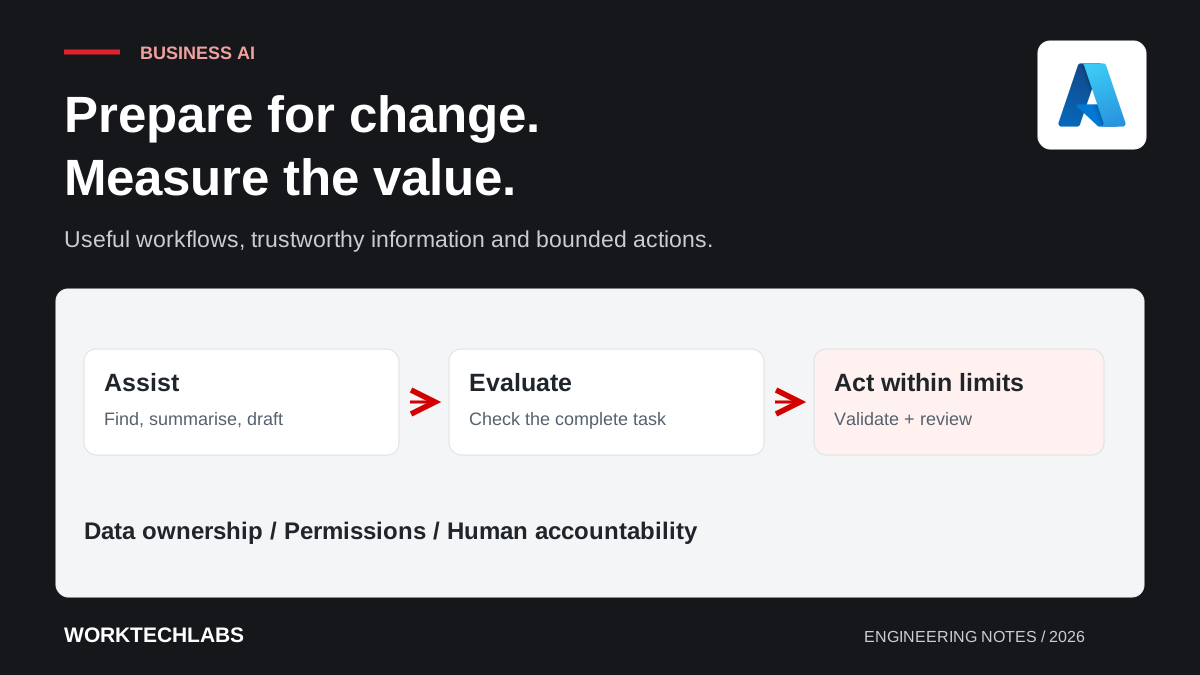
An assistant can make an existing system easier to use by helping a person find information, summarise a record or draft a response. That can be valuable even when the underlying transaction still follows the same business rules. A better interface does not require handing every decision to a model.
Consider a hypothetical maintenance company. A technician needs the service history and relevant instructions for a piece of equipment. An assistant could gather authorised information and present a short briefing with source references. The technician still decides what action to take, and the established system still records the completed work.
This is a useful planning distinction because assistance and automation have different failure consequences. A poor draft can be corrected before use. An incorrect action that changes stock, sends a message or authorises a payment creates additional work outside the conversation. Evaluate the proposed capability at the level of its actual effect.
Invest in access to trustworthy information
An AI feature becomes less useful when the information it needs is missing, outdated or contradictory. Businesses considering AI should examine document ownership, data quality and the interfaces through which applications access records. These are valuable improvements even if the first AI experiment does not proceed to production.
Retrieval-augmented generation, often shortened to RAG, is one approach to providing relevant source material to a model at request time. It still needs decisions about ingestion, retrieval quality, answer quality and evaluation. Microsoft's RAG design and evaluation guide explains those distinct stages. Supplying documents can improve context; it does not guarantee that every answer is correct.
Ask who maintains each source, how a correction reaches the assistant and how the application handles missing evidence. A confidently written answer should not hide uncertainty about the source. Where the material is insufficient, a clear explanation of that limitation is often the most useful response.
Build bounded actions before broad autonomy
The word “agent” can describe systems with very different degrees of freedom. For planning purposes, define the exact actions a proposed feature may take, the information it may use and the point at which a person must review the result. A narrow workflow is easier to evaluate than a general promise that an agent will handle operations.
A first action might be creating a draft service ticket from a reviewed summary. A later action might assign a category when the case meets agreed conditions. Each step should use ordinary application permissions and validation. The model can propose an action, while trusted server-side code decides whether that action is allowed.
Bound the work as well as the permissions. Set limits for retries, processing time and the number of operations a request can initiate. A workflow that gets stuck should produce an understandable state for support staff rather than continuing indefinitely or silently abandoning the task.
Measure the whole task, including review
A convincing demonstration can conceal the cost of checking the output. If an assistant drafts an answer quickly but the reviewer spends longer verifying it than writing it, the business benefit is uncertain. Measure completed work: preparation, generation, review, correction and follow-up.
Define evaluation examples before selecting a model. Include routine cases, unusual cases and requests the system should decline or escalate because it lacks evidence or permission. Score the behaviours that matter to the workflow: correctness, completeness, source support, inappropriate disclosure and the ability to recognise a limit.
Avoid relying on the model's own confidence statement as a decision rule. A numerical-looking confidence score is not automatically calibrated to the probability of being correct. Use observed results from representative evaluations and explicit business checks to decide when a person needs to review the output.
Make accountability part of the product
People need to understand when they are seeing generated content and how to correct it. Give them access to the relevant source information, an escalation route and a way to report a useful or misleading result. The feedback must reach someone who can change the system rather than disappearing into an unused rating widget.
Responsibility should remain clear when several components are involved. Name the business owner of the workflow, the team responsible for the integration and the people who review its performance. Microsoft's responsible AI guidance for workloads provides a framework for considering these concerns in context; the application still needs its own concrete operating decisions.
Keep audit records proportionate to the task. They may need to identify the model configuration, source records, proposed action and human decision. Avoid retaining sensitive prompts indefinitely simply because storage is available. Decide what evidence is useful and how access and retention will be managed.
Design for model and provider changes
An architecture that places model calls directly throughout business code can make future changes unnecessarily expensive. Put the AI integration behind a clear application boundary and keep business validation separate. Record prompts, evaluation cases and configuration in a way that allows the team to compare versions.
Portability has limits. Different models can interpret prompts differently, support different features or behave differently on the same task. A common interface can reduce integration work, but it does not eliminate the need to evaluate a replacement. Treat a model change as a product change with acceptance evidence.
Have a degraded mode for provider outages, rate limits or unacceptable output. A staff workflow may fall back to manual processing or a conventional search interface. Make that route visible and usable so the business can continue operating while the team investigates.
Choose a portfolio of experiments you can stop
Select a small number of opportunities with a clear user, accessible information and a measurable outcome. State the hypothesis, evaluation method, review effort and conditions for stopping. An experiment that shows a task is unsuitable for current AI capability has still produced useful planning evidence.
Separate strategic readiness from immediate adoption. Improving APIs, permissions and data ownership can support several future use cases. Buying a large platform before identifying a workable task may create commitments without resolving the underlying uncertainty. Our guide to adding AI to legacy applications shows how a bounded first feature can fit into an existing system.
Worktechlabs helps teams assess business AI opportunities through practical workflows, integration design and evaluation. The strongest preparation for the future is an organisation that can test a new capability, measure its effect and decide whether to expand it with evidence.