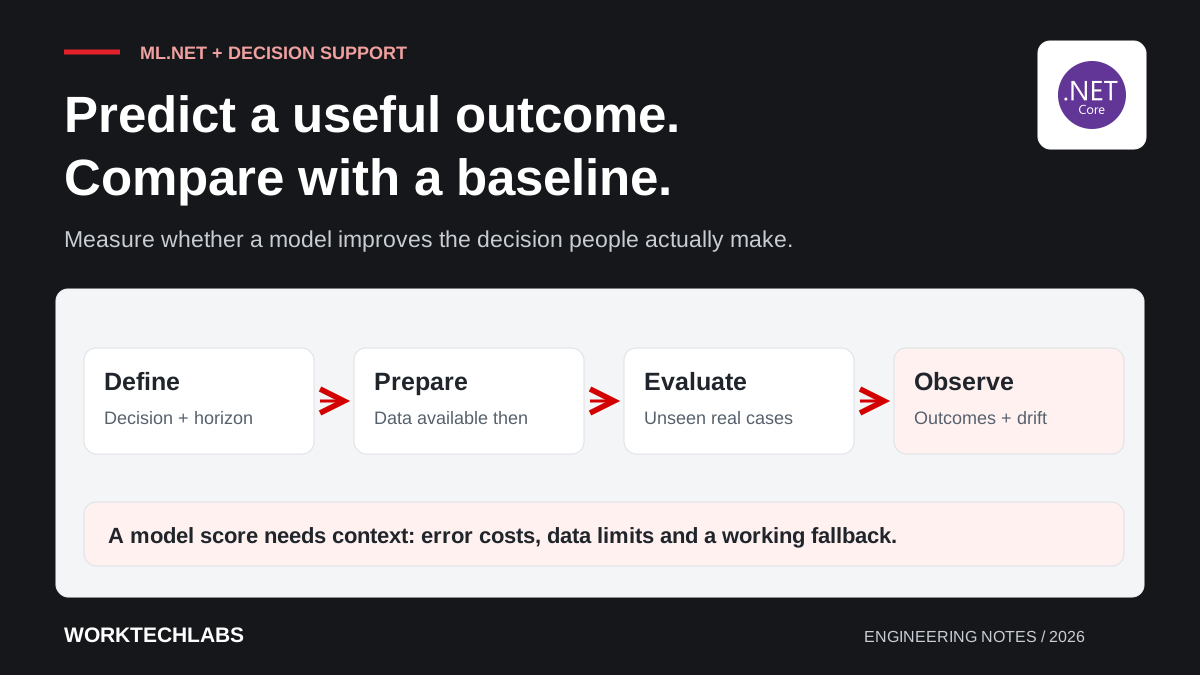
A business may already hold years of order history, service records or equipment readings while still making routine decisions from a spreadsheet and experience. Machine learning can be useful when those records contain a repeatable relationship that helps a person decide what to do next. The first question is whether a prediction would change the decision enough to justify maintaining it.
Imagine a hypothetical parts distributor planning weekly replenishment. A forecast could help identify likely shortages, but a prediction is not a purchase instruction. Lead times, stock constraints and unusual customer commitments still matter. A sensible project connects the model to that wider decision rather than treating a score as the finished product.
Start with the decision and a simple baseline
Write down who will use the prediction, when it is needed and what action it informs. Specify the time horizon: next week's demand is a different problem from the next quarter's purchasing plan. Include the cost of a wrong recommendation and the capacity available to review uncertain cases.
Establish what the business currently does. The baseline might be the same period last year, a recent average or an experienced planner's estimate. Record its results using a fair evaluation period. A model that cannot improve on a simple, understandable approach may add maintenance without useful decision support.
Choose a narrow starting scope. A stable product family with enough history can be easier to evaluate than every product and location together. State why it was selected and what would need to be learned before extending the approach. This keeps a successful pilot from being interpreted as evidence for unrelated decisions.
Check whether the available data matches the prediction
Identify the information that would genuinely have been available at prediction time. A field entered after a delivery completes cannot fairly be used to predict that delivery's outcome. Such leakage can make historical evaluation look impressive while the deployed model performs poorly when the future information is absent.
Inspect missing records, changed definitions and operational interruptions. An apparent fall in demand may reflect unavailable stock rather than reduced customer interest. A new product code may divide one product's history into two records. Ask the people who use the system to explain these patterns before choosing a training method.
For the distributor, create a data note describing how returns, cancelled orders and stockouts are represented. Record unresolved limitations next to the evaluation results. The aim is to make the model's evidence understandable, including the situations in which a forecast should be treated with particular caution.
Select the modelling task deliberately
ML.NET supports different machine-learning tasks through its .NET APIs. The task determines the training approach and suitable evaluation measures. Forecasting a quantity, assigning a category and detecting an unusual pattern should not be assessed as if they were the same problem. Microsoft's ML.NET overview.
Keep the first comparison small enough to interpret. Try an appropriate baseline and a limited set of candidate approaches with the same evaluation conditions. Record data preparation as part of each candidate, because a transformation or missing-value rule can affect the result as much as the selected learner.
Avoid choosing the final approach solely because it produces the best aggregate score. Consider whether it can run within the required time, whether failures are diagnosable and how easily the team can reproduce its inputs and output. A business prediction has an operating lifecycle after the experiment ends.
Evaluate in a way that resembles future use
Separate model development from final evaluation. Where the decision is time-dependent, use an evaluation design that respects time and prevents future information entering the training process. Keep the final test period useful for assessing how the approach would have behaved on data it had not already used.
Microsoft documents task-specific ML.NET metrics, including measures for classification and regression. Use the relevant technical measures, then connect them to business consequences. An error that creates a small surplus is not necessarily equivalent to one that causes an urgent stockout. ML.NET evaluation metrics.
Review performance across meaningful groups and difficult periods. An average can hide weak results for a small but important product category. Present examples of incorrect predictions and explain how a planner would notice and handle them. That discussion often reveals whether the proposed feature is operationally useful.
Introduce predictions as decision support
Show the prediction with its relevant context: horizon, calculation time and any known input limitations. Give the planner an understandable way to compare it with current stock and upcoming commitments. Avoid presenting an estimated value with visual precision that implies certainty the model does not establish.
Define when human review is required. A new product with little history, a missing feed or an unusual event may need a different workflow. Let users record a reason for overriding a recommendation where that information will be used constructively, without assuming every override means the model was wrong.
Start by observing recommendations alongside the existing process. Compare decisions and outcomes before granting the feature greater influence. This creates room to identify data problems and user misunderstandings without making the first experiment responsible for every replenishment action immediately.
Own the model after launch
Version the training data definition, preparation steps and deployed model so a particular prediction can be investigated. Decide how often performance is reviewed and what evidence triggers retraining or withdrawal. Retraining on a schedule alone does not establish that the new model is better.
Monitor missing inputs and changes in the populations the model sees. A supplier change or a new sales channel can alter the operating context. Keep a fallback that the planning team can use when predictions are unavailable or no longer dependable, and make that transition visible.
Worktechlabs can help evaluate practical AI and machine-learning features against measurable business decisions. A useful starting engagement combines a data quality review, a simple baseline and a bounded experiment, with the result expressed as evidence for the next investment rather than a promise that more data automatically creates better decisions.
Official sources and further reading
- Microsoft: what is ML.NET? — framework and task overview.
- Microsoft: ML.NET evaluation metrics — measures appropriate to different modelling tasks.
- Microsoft: train and evaluate a model — training and evaluation workflow.