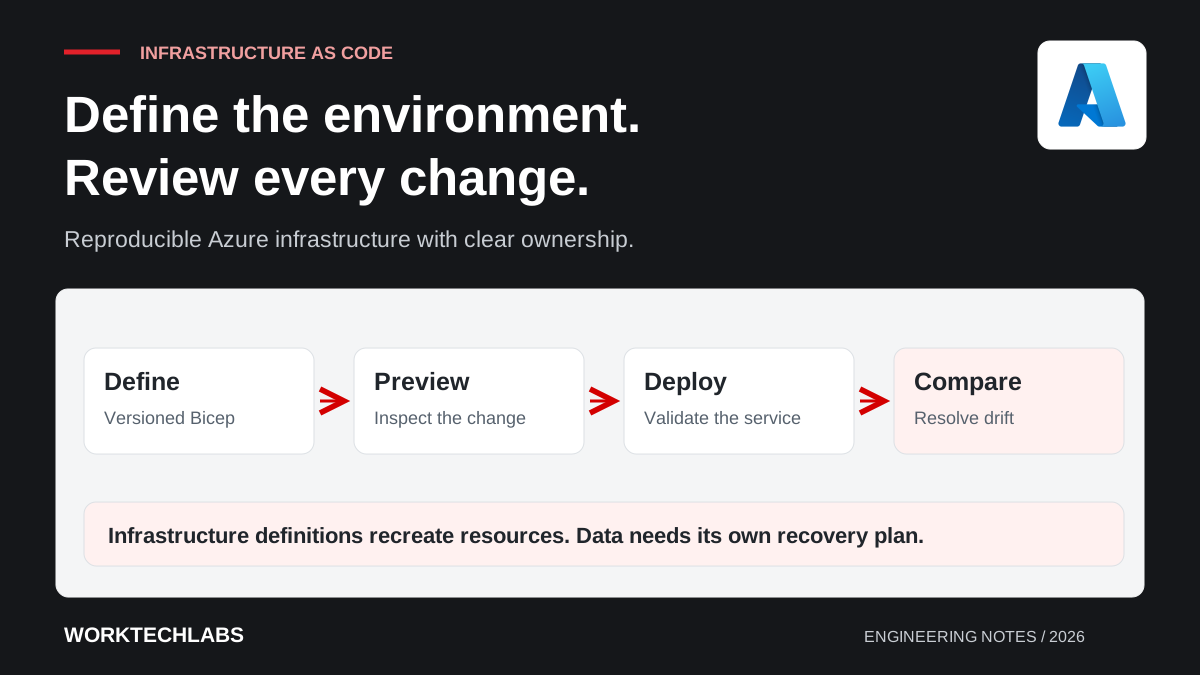
An Azure environment can become difficult to understand one reasonable portal change at a time. A developer increases capacity during a busy week, someone opens a network route for a supplier, and a test application receives a setting that never reaches staging. Each change may solve an immediate problem. Together, they create an environment that is hard to reproduce or review.
Infrastructure as code gives the team a maintained description of what should exist. It makes infrastructure changes available for review alongside application changes and provides a repeatable starting point for new environments. Its value depends on how the team manages that description, including the differences that cannot be removed simply by running a deployment.
Start with an environment you can explain
Choose a bounded application or environment for the first implementation. List its resources, identities, connections and configuration inputs. Include the resources that are easy to forget: monitoring, storage, scheduled processing and the access needed by the deployment process itself.
Distinguish application-owned resources from shared infrastructure. An application team should understand whether it is allowed to modify a shared network or whether another owner supplies that dependency. Record those boundaries before converting portal settings into files, otherwise the first automated deployment may attempt to manage more than intended.
For a hypothetical customer portal, the first scope might include its hosting plan, web application and monitoring resources. A shared database could remain an explicitly referenced dependency until its ownership and change process are agreed. A small, complete boundary is easier to adopt than an ambitious template nobody can confidently run.
Treat the definition as a product asset
Bicep is Microsoft's declarative language for defining Azure resources. Its overview describes resource declarations, reusable modules and the ability to preview proposed changes. It is one practical option for an Azure-focused team; the larger principle is keeping the intended infrastructure in a reviewed, reproducible form.
Keep definitions in version control and connect each change to a reason. A reviewer should be able to see that a capacity change supports a measured workload, or that a network change enables a specific integration. Files full of unexplained settings can be just as difficult to maintain as an undocumented portal configuration.
Assign an owner to the definitions and their deployment process. Someone must keep them aligned with the application as its needs change. If infrastructure code is updated only during occasional projects, it soon becomes an inaccurate description of a production environment that has continued evolving.
Parameterise differences that have a purpose
Production and development often need different capacity, names or dependency endpoints. Represent those differences explicitly, while keeping common behaviour in a shared definition. This makes it easier to distinguish an intentional variation from an accidental one.
Avoid turning every property into a parameter. A module with dozens of poorly explained switches can make routine changes harder to review. Choose parameters that express the decisions callers actually need to make, and give their accepted values a clear meaning.
Keep secrets out of ordinary parameter files and deployment output. Use the environment's approved secret or identity mechanism, and document how the deployment receives permission to use it. A reproducible environment should not depend on copying a password out of a colleague's notes.
Review the change that will actually happen
Validate definitions before deploying them, then inspect the proposed resource changes in the target environment. A preview helps identify surprising modifications, but it is not a guarantee that a deployment will succeed or that an application will remain healthy. Permissions, external dependencies and platform behaviour still matter.
Pay special attention to changes that can replace resources, remove access or affect retained data. Review the intended target subscription and resource scope as part of the same decision. A technically valid definition deployed to the wrong environment is still a serious operational error.
Use a production approval that presents evidence rather than just a button. The reviewer should understand the intended effect, the observed preview and the recovery route. Keep the process proportionate: changing a descriptive tag does not carry the same consequences as changing how a production database is reached.
Handle existing resources deliberately
Adopting infrastructure as code does not require recreating an entire environment immediately. It does require understanding how the chosen tooling represents existing resources and which properties it will manage. Compare the definitions with the real environment before allowing automation to make broad changes.
Work through one resource group or application boundary at a time. Confirm that deployment preserves expected settings and that the application still performs its important journeys. Document any resources that remain manually managed, with a reason and a clear ownership boundary.
Do not assume infrastructure definitions are backups. Recreating a database resource does not recreate its business records, and rebuilding an application host does not recover documents that were stored only on its local disk. Pair the definitions with a separate recovery plan for stateful information.
Detect and resolve drift
Drift occurs when the live environment differs from the maintained definition. Sometimes it reflects an emergency fix; sometimes it reflects an unnoticed manual change. The team needs a way to discover the difference and decide which version expresses the desired state.
During an incident, a manual adjustment may be appropriate. Record it and reconcile the definitions afterwards so the next deployment does not unexpectedly reverse the fix. Simply banning all portal changes can be impractical; allowing changes without a reconciliation process creates a different problem.
Review drift regularly and investigate recurring causes. If the same setting keeps changing outside the normal process, perhaps the process is too slow, the ownership is unclear or the application needs a different operating model. The discrepancy is evidence worth understanding, not just something to overwrite automatically.
Prove that another person can recreate the environment
Use a controlled environment to test the complete setup from documented inputs. Include identity assignment, configuration, application deployment and a meaningful health check. A successful resource deployment that leaves the application unable to access its database is an incomplete result.
Have someone other than the author perform the exercise. Note every undocumented permission, local tool and manual correction they need. These details expose the difference between a collection of files and a process the business can actually depend on.
Measure practical outcomes: time to prepare an environment, frequency of configuration mistakes and the work required to recover a missing component. Those measures connect the investment to everyday delivery. Worktechlabs can help introduce Azure infrastructure and application automation alongside CI/CD, so environment changes become reviewable parts of the product.