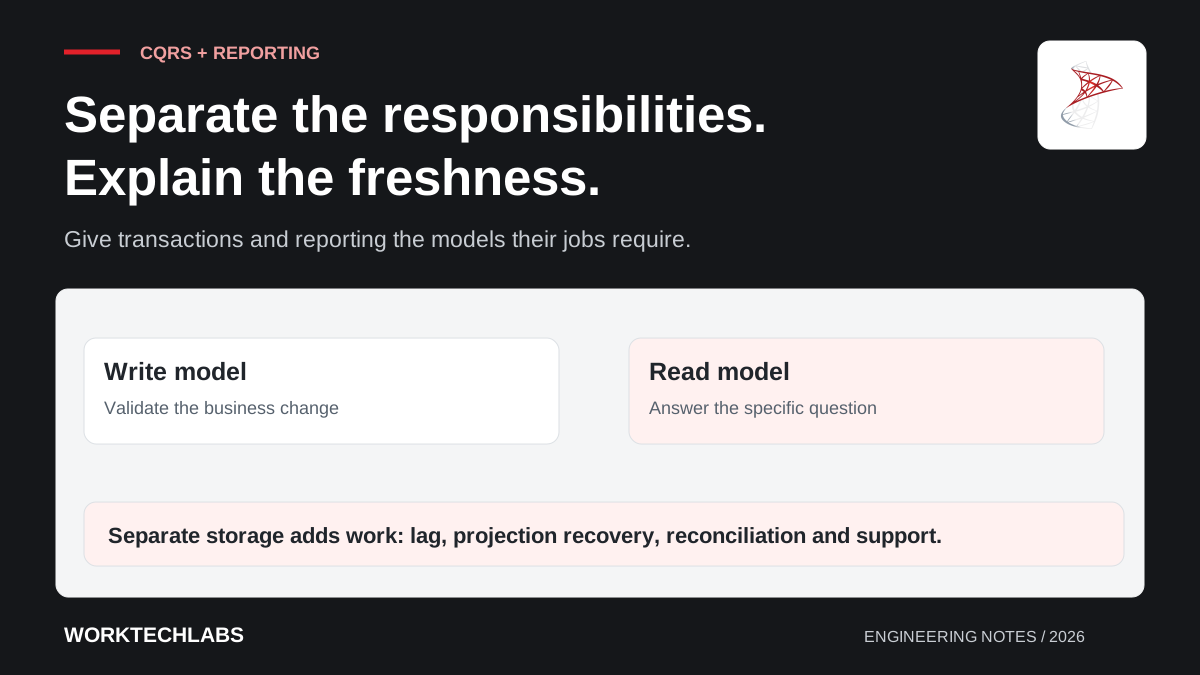
An order-entry application and a management dashboard can need very different views of the same business. The application must validate changes and preserve correct transactions. The dashboard wants totals, trends and combinations of information across a long history. Problems arise when the team forces every use case through the same growing set of objects and queries.
CQRS, or Command Query Responsibility Segregation, separates the responsibilities of changing information and reading it. That separation can be modest: distinct models within one application and one database. More elaborate forms introduce separate storage and asynchronous updates, which bring additional operating responsibilities. The appropriate scale follows the problem being solved.
Identify the tension before adopting the pattern
Write down the actual difficulty. Are reporting queries too expensive, are transaction models awkward for the interface, or does every dashboard request require loading information it does not need? These are different problems and may have simpler solutions than a separate reporting platform.
For a hypothetical wholesaler, the order screen needs current line items and approval rules, while a weekly sales dashboard needs totals by region and product category. Inspect the current query workload and development friction. A carefully designed projection or query may resolve the problem without introducing another database.
Microsoft's CQRS guidance describes both basic separation and more advanced architectures, including their complexity. Use it as a decision aid, not a requirement to adopt event sourcing or independently deployed services. Those choices are distinct and should each have a reason. CQRS pattern.
Start with separate responsibilities inside the application
Define operations that change business state and queries that return information for a specific purpose. A command to approve an order should enforce the relevant rules. A query for a dashboard can return an intentionally shaped result without pretending that the display needs the full editable order model.
Keep the read contract focused on the consumer. Include the values and explanations the screen requires, with clear filtering and pagination. Avoid making every query return a generic object that gradually accumulates unrelated fields because several screens happen to use it.
This first separation can remain within the existing deployment and database. Evaluate whether it improves clarity and query behaviour before adding distributed infrastructure. The team should be able to describe the benefit in concrete terms, such as a simpler report query or fewer accidental dependencies between editing and display code.
Define freshness before separating storage
If a separate read store is justified, decide how quickly it must reflect changes. A weekly analysis may tolerate a delay that would be unacceptable for a stock-availability decision. Treat freshness as part of the query contract and the user experience, not an incidental property of the processing pipeline.
Show the relevant update time or processing state where it affects interpretation. “Data updated through 10:15” has a different meaning from the browser's current clock. If some sources are behind others, consider whether one overall timestamp could give the user a misleading impression of consistency.
Describe what happens immediately after a user makes a change. They may expect to see the new order on returning to a list. Options include reading the authoritative record for that confirmation or showing a clear processing state. Choose deliberately rather than leaving users to repeatedly submit an action that appears to have disappeared.
Make projection processing recoverable
Define how changes reach the read model and how the team knows they were applied. Preserve enough identity and version information to handle repeated or out-of-order inputs according to the selected design. A background process should expose progress and failures rather than silently skipping inconvenient records.
Plan how the read model can be rebuilt or repaired. Record its transformation rules and the source information required for reconstruction. A rebuild that takes hours may be acceptable for one report and unacceptable for an operational screen, so include that duration in the decision to separate storage.
Reconcile meaningful totals against the authoritative system. For the wholesaler, compare order counts and agreed sales measures over a defined period, with known exclusions documented. A processing job that completes successfully can still apply an incorrect transformation. Our reporting data guide explores this distinction in more detail.
Keep permissions and business meaning consistent
A reporting store can expose information through a different route from the transaction application. Apply the required tenant and user boundaries to its queries, exports and administrative tools. Copying data into a convenient analytical shape does not remove the responsibility to control who can see it.
Agree definitions with the people who use the report. “Sales” might refer to submitted orders, approved orders or issued invoices. A technically efficient read model can make a mistaken definition spread more quickly. Record the measure's meaning and connect it to examples that finance or operations can verify.
Handle historical changes explicitly. If a customer's region changes, should last year's report use the current region or the region at the time of the sale? Neither answer is universally correct. The model should preserve or derive the information required by the agreed interpretation rather than make that choice accidentally.
Judge the operating cost as well as the code structure
List the new responsibilities introduced by the design: processing lag, rebuilds, duplicate handling, schema evolution and incident investigation. Assign owners and include those tasks in the estimate. Separating read and write concerns can improve one area while increasing the work needed to operate the whole system.
Use a bounded rollout, such as one management report, to evaluate the approach. Compare its correctness, freshness, performance and maintenance effort with the previous implementation. Keep the evidence specific so a useful reporting improvement does not become a blanket justification for restructuring every application feature.
Worktechlabs can help assess business application architecture and reporting requirements. Begin with the simplest separation that resolves the observed problem, keep authoritative transactions clear, and add independent storage only when its benefits justify the consistency and operational work it introduces.
Official sources and further reading
- Microsoft: CQRS pattern — forms of separation, trade-offs and applicability.
- Microsoft: efficient querying with EF Core — query-level improvements to consider before increasing architectural complexity.