Architecture discussions often treat microservices as a destination that every successful application must eventually reach. That assumption can encourage a young team to split its product into services before it understands the business boundaries or has a dependable way to operate them.
A more useful decision starts with the change you need to make easier. Do separate teams need independent releases? Does one workload have a very different scaling pattern? Does a boundary require strong isolation? Or is the immediate problem that the code is difficult to understand? These questions lead to different solutions. More deployment units do not automatically create a better organised application.
Distinguish code boundaries from deployment boundaries
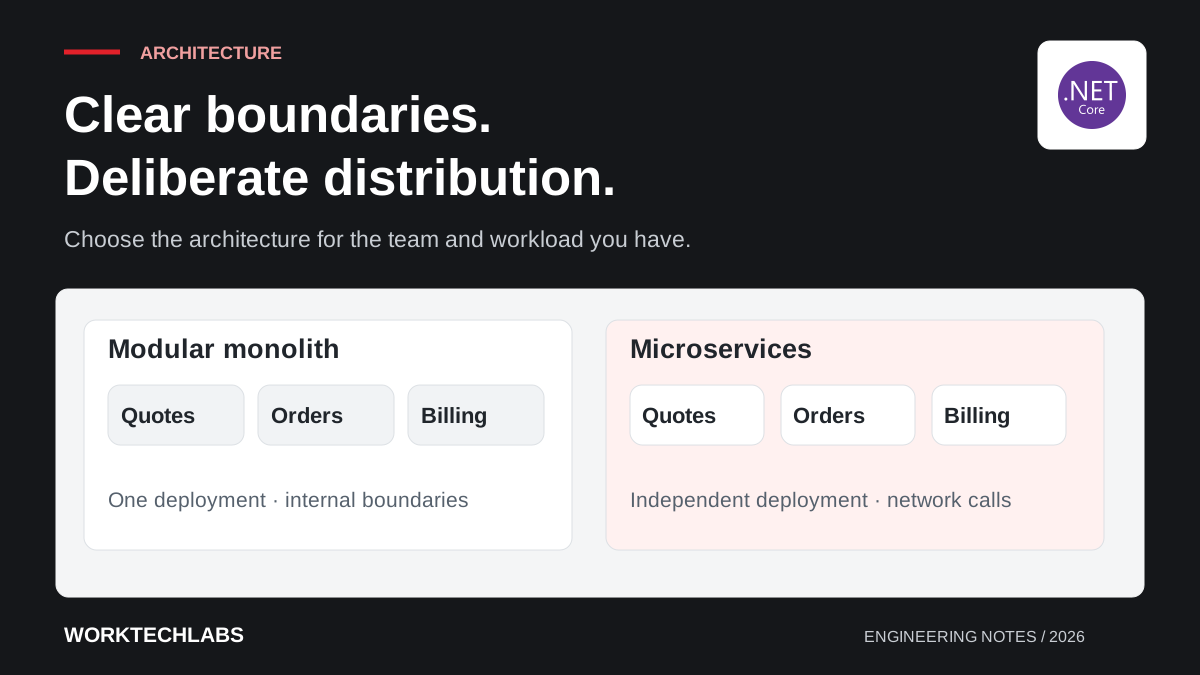
A monolithic application is typically deployed as one unit, but its code can still be divided into clear modules with controlled dependencies. A modular monolith uses those internal boundaries to keep business capabilities understandable while retaining a relatively simple deployment model.
Microservices separate capabilities into services that can be deployed independently. Communication between them crosses a network or messaging boundary, introducing concerns that do not exist in the same form inside one process. Independence is valuable when the organisation can use it; it also has a cost.
Microsoft's guidance on common web application architectures describes how an application can maintain logical separation while remaining a single deployment. For a .NET team, several projects or modules in one solution do not require separate services to be useful boundaries.
Find boundaries in the business workflow
Begin with capabilities such as quoting, scheduling, stock management or invoicing. Identify the rules and data each capability owns, and the information it needs from others. Avoid dividing solely by technical layers if the objective is independent business change: one service for screens and another for database access can still require coordinated changes everywhere.
Look for terminology that changes meaning across contexts. A customer in a sales workflow may have different rules from an account in finance. That difference can reveal a useful boundary, but it does not immediately require separate databases or network calls. First make the ownership and contract clear.
Test the boundary against ordinary changes. If adding a routine pricing rule requires edits across most modules, the proposed separation may not reflect the business. If every service must be released together, the architecture has acquired distributed operations without achieving much release independence.
Understand what a modular monolith can offer
For a small team, one deployable application can simplify local development, debugging and release coordination. Business rules can still live in separate modules, and the team can enforce which interfaces other modules are allowed to call. The key is discipline around those boundaries.
Data ownership matters even when modules share a database. A module should not casually bypass another module's rules by updating its tables directly. Use explicit application contracts for important operations and record exceptions. Without that discipline, the application may become difficult to separate later regardless of how neatly its folders are named.
A single deployment also has trade-offs. The team may need to release the whole application for a small change, and scaling one capability may mean scaling the process around it. Assess whether those costs are material for the current workload. A theoretical inefficiency is not always worth replacing with an immediate operational burden.
Recognise the real costs of distribution
Once a call crosses a network, it can be delayed, rejected or completed even when the caller never receives a response. The application needs timeouts, retry rules and protection against duplicate effects. A local method call and a remote service request are not interchangeable just because their interfaces look similar.
Data consistency becomes a design decision. If an order spans inventory and billing services, explain which state is authoritative and what happens when one step succeeds while another fails. Some workflows can tolerate eventual consistency; others need a different boundary or an explicit coordination process. Splitting data first can make these questions much harder to resolve.
Operations also multiply. Each service needs deployment, configuration, monitoring and ownership. Engineers need a way to follow one user action across several components. Before adding services, assess whether the team can observe the workflow and diagnose partial failure without depending on the original author of every component.
Choose microservices when independence solves a concrete problem
Independent teams with distinct release cadences can benefit from services that let them make changes without coordinating every deployment. A component with substantially different resource needs may also justify separation. The decision should explain the independence being purchased and how the organisation will use it.
A hypothetical document-processing product might keep account management, billing screens and customer workflows in one application while running document conversion as a separate worker. The worker has a distinct workload and can communicate through a defined queue contract. That selective separation can solve a real problem without turning every business noun into a service.
There are also constraints that favour separation earlier, including specific isolation requirements or an existing platform with mature operational support. Evaluate those requirements directly. The right choice depends on the application and team, not on a universal rule that one architecture is modern and the other outdated.
Make contracts and ownership explicit
Whether the boundary is internal or distributed, define what it promises. State input validation, outcomes, failure behaviour and who owns the interface. Keep consumers from depending on internal data structures that the owning module needs to change.
Version external contracts carefully. A service deployment may need to support older clients or messages already waiting in a queue. Contract tests can help check compatibility, but they need examples representing actual consumer expectations rather than simply repeating the provider's current implementation.
Assign operational ownership alongside code ownership. If one team publishes a service that several others depend on, establish how changes, incidents and support requests are handled. Independence should reduce unnecessary coordination while preserving the communication required to keep the wider workflow usable.
Design a credible path to change
A modular monolith can be a starting point with deliberate extraction options. Keep boundaries clear, avoid uncontrolled table access and observe where performance or release contention actually occurs. Those signals can help the team choose a capability to separate later.
Extraction still requires work. Moving a module into a service changes transactions, failure modes, latency and deployment. A clean interface helps, but it does not remove those consequences. Plan the migration as a product change with compatibility checks and a recovery strategy.
The reverse decision can also be sensible. If several tiny services are always changed and deployed together by the same team, consolidating them may reduce operating effort. Evaluate the resulting behaviour and maintainability rather than treating the number of services as a measure of architectural progress.
Record the decision and its review triggers
Write a short decision record describing the workload, team structure, main constraints and chosen architecture. Include the disadvantages you accept and the evidence that would prompt a review. For example, repeated contention between independent teams or a measured scaling mismatch may justify revisiting a single deployment.
Avoid a roadmap that promises microservices simply after a particular date or customer count. The trigger should relate to a problem the architecture can solve. That keeps the team from taking on distributed complexity just as it is learning how customers use the product.
Worktechlabs can help with architecture and code reviews and .NET application development. For a startup, connect the decision to the first useful release: choose boundaries that help the team deliver now and make future change understandable.