
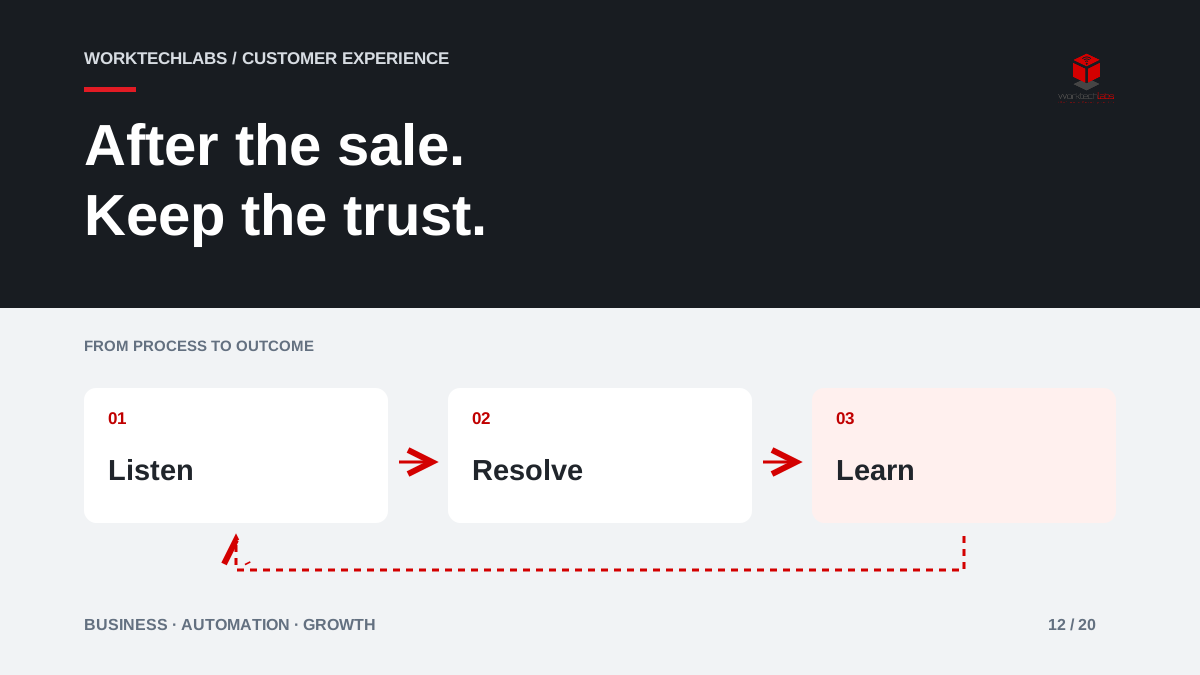
A customer may like your product and still hesitate to buy again after an unresolved support request. They do not know who owns the issue, repeat the same explanation and receive a sales message while waiting for help. Retention depends partly on how consistently the business handles these moments after the initial transaction.
Service automation can make requests visible, preserve context and coordinate the next action. It supports a dependable relationship when the measures focus on resolution and customer effort, rather than closing records as quickly as possible.
Give every request a recognisable history
Customers contact a business through email, forms, calls and existing account relationships. Decide how those requests become a shared record without losing the original explanation. A reference helps the customer and the team connect later messages to the same issue.
Avoid creating a new case for every reply. Equally, do not merge unrelated problems merely because they involve the same customer. Staff need to understand what is being resolved and which conversation belongs to it. Clear identity and context are the foundation for useful routing, status updates and reporting.
Route by the help required
Use categories that lead to an action: delivery query, product issue, account change or technical investigation. A category that only looks good in a report may add little value to the person trying to resolve the request. Allow staff to correct the classification without restarting the conversation.
Microsoft documents rules for creating and updating customer service records from incoming activities. These can provide a starting point for intake automation. Your own routing should also account for existing ownership, urgency and the information available. An unclear request should enter a review queue with a responsible team, rather than disappear because it failed a classification rule.
Separate acknowledgement from progress
Confirm that the request arrived and explain what happens next. Then provide updates when there is meaningful progress or when an agreed expectation changes. Repeating “we are working on it” on a fixed schedule can become frustrating if it hides the fact that a decision is blocked.
In an illustrative equipment business, a replacement request might be waiting for a photograph, a supplier decision or dispatch. Each state needs a different explanation and next action. Show whether the customer needs to do something and who is responsible for the remaining work. This reduces uncertainty without promising a resolution date that has not been confirmed.
Make escalation a route to a decision
An overdue case needs an owner who can remove the obstacle. Sending more notifications to the original queue is not necessarily an escalation. Decide who can approve an exception, arrange a replacement or coordinate another department, and provide the context they need.
Keep a visible record of commitments made during the case. If a colleague promises a callback or a document, that action should remain attached to the request. A handover during leave should preserve those commitments so the customer does not experience every staffing change as a fresh start.
Connect support context to account activity
The account team should know when a significant unresolved issue affects the relationship. That does not mean every salesperson needs access to every sensitive support detail. Share the relevant status and the person to consult so commercial activity can be timed and framed appropriately.
Avoid triggering an enthusiastic renewal or referral request while a serious complaint remains unresolved. Define which service events should pause automated account messages. When a problem is resolved, a personal check that the outcome worked may be more appropriate than an immediate request to buy more. The relationship should determine the action, rather than the convenience of a campaign schedule.
Learn from repeated problems
Review recurring reasons for contact, reopened cases and issues that pass through several teams. Some support demand can be reduced by clearer delivery information, better onboarding or a correction to the product. Automation should help reveal these patterns, not merely process the same avoidable problem faster each month.
Measure time to a useful response, time to a confirmed resolution, repeated explanations and the customer's ability to complete the next task. Distinguish a record closed by staff from an outcome confirmed with the customer where confirmation is practical. Retention can then be examined alongside service experience, without claiming that every repeat purchase was caused by one workflow change.
Start with one service journey
Choose a frequent request type with an identifiable owner and outcome. Connect intake, status, outstanding actions and closure. Test duplicate replies, missing information, a handover and a case reopened after an apparent resolution. The team should be able to explain the process without referring to a technical flowchart.
Worktechlabs can help connect customer service with your CRM, ERP or existing applications, making ownership and account context easier to use. Tell us which requests create the most chasing for customers. We can identify a focused improvement that supports repeat business by making the service behind it more dependable.
Official sources and further reading