An export works during a demonstration but disappears when the web application restarts. A scheduled import runs twice after the application scales to two instances. A user clicks a button again because the first request timed out, and two copies of the same work begin processing. These problems arise when background execution is added without defining the job's lifecycle.
Moving work out of an HTTP request can improve responsiveness, but it also creates a responsibility to track that work until it reaches an understood outcome. A reliable job has an identity, durable state where required, controlled execution and a useful result for the person or system that requested it.
Decide whether the work must survive a restart
Distinguish optional in-process activity from business work the system has promised to perform. Refreshing a disposable cache and generating a customer export have different durability needs. If losing a process must not lose the work, record the commitment in durable storage or a suitable queue before reporting acceptance.
.NET provides hosted-service abstractions for running background logic within an application host. Microsoft's documentation on hosted background tasks explains that execution model. A hosted service does not, by itself, make queued work durable or guarantee that a scheduled action runs once across several instances.
Choose the execution arrangement from the workload. An application-owned worker may be sufficient for some tasks; a separately operated worker may fit different scaling or reliability needs. In either case, the job's durable state and processing rules need their own design.
Model the job as a visible lifecycle
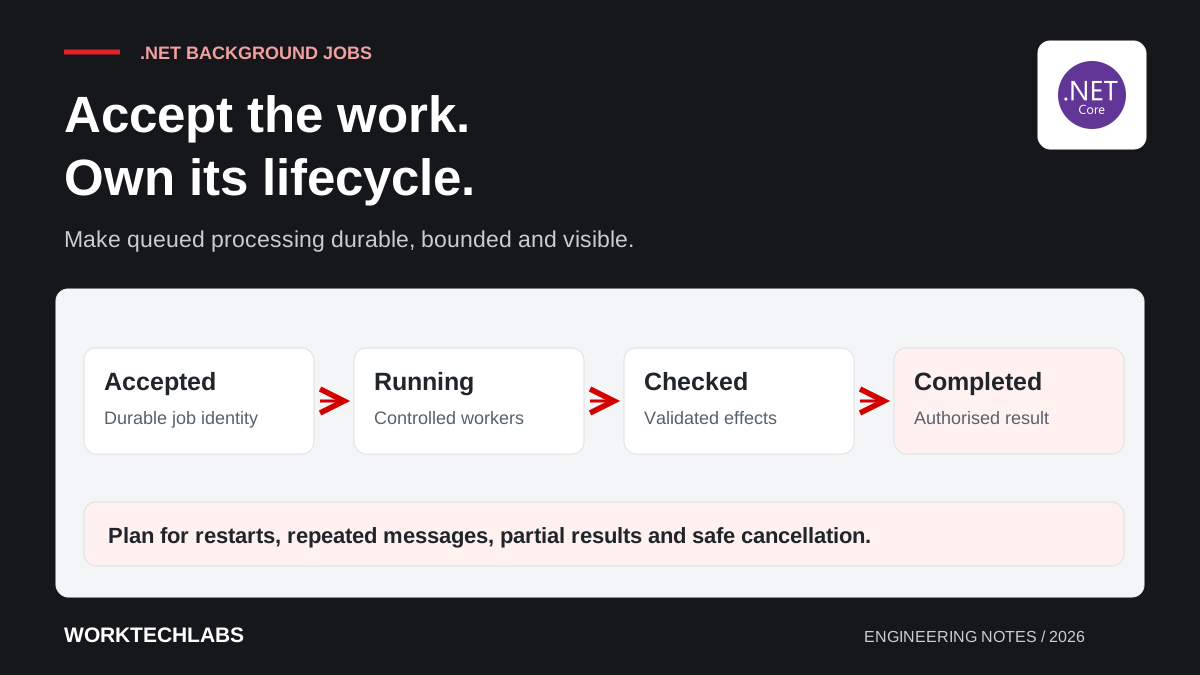
Use states that communicate what happened: accepted, running, completed, failed or awaiting review, for example. Define which transitions are allowed and what evidence supports completion. Avoid reporting success merely because the request to start work was received.
Store a stable job identifier and the minimum information required to process the task correctly. Include the relevant tenant or business context and the version of the requested input where needed. Do not depend on a browser session still existing when the worker starts later.
For a hypothetical stock export, the requesting user could receive a job reference and a status page. The result should explain whether the export reflects a snapshot or data read during processing. That distinction matters if stock changes while a large job is running.
Expect interruption during every important step
A worker can stop after it reads a message, after it writes part of the result or after it completes an external action but before acknowledging success. Design what happens when execution resumes at each of those points. Assuming the process always reaches its final line leaves the most consequential behaviour undefined.
Use duplicate protection for effects that must not be repeated. A stable operation identifier, a recorded completed step or an appropriate uniqueness rule can help distinguish a retry from new work. The mechanism should match the actual business effect rather than simply preventing two workers from starting at the same moment.
For multi-step jobs, decide whether to checkpoint progress, restart from the beginning or compensate for completed work. Keep intermediate states understandable. A partially generated file might be safely discarded, while a partly completed external submission may require reconciliation before another attempt.
Coordinate workers and schedules explicitly
Scaling an application can create several instances of its background service. Determine how work is claimed and how another worker detects that a claim has expired after a failure. Use the guarantees of the selected queue or coordination mechanism deliberately rather than relying on a static variable in one process.
Scheduled jobs need the same attention. A timer in every application instance can produce repeated execution, and a stopped application can miss a scheduled run. Define whether missed work should be caught up, skipped or reviewed, and how overlapping runs are handled.
Record the relevant time basis. A daily task tied to a customer's local day is different from a fixed UTC interval, particularly around daylight-saving changes. Keep scheduling rules separate from the displayed time so the job does not silently change meaning when the application is moved to another environment.
Bound concurrency, retries and processing time
Set limits that reflect the capacity of downstream systems. Running more workers can overwhelm a database or supplier API instead of completing work sooner. Measure how concurrency affects the entire workflow and choose bounds that preserve useful service for interactive users.
Classify failures before retrying. Invalid input should usually become a correction task, while a temporary dependency failure may justify another attempt after a delay. Keep a total attempt or time limit so a permanently failing item does not consume resources indefinitely.
Provide an exception queue or equivalent operational view. It should explain the failed job, relevant attempts and permitted next actions. Reprocessing should be an informed decision, especially when previous attempts may already have created effects outside the worker's own database.
Make progress and cancellation meaningful
Expose status in terms the user can understand. If precise progress cannot be measured, a clear processing stage may be better than an invented percentage. Include an expected response route for jobs that exceed their normal duration so users do not create more work by repeatedly submitting the same request.
Define cancellation carefully. A cancellation request may stop future steps without reversing work already completed. Tell the user what the system can stop and whether any result or external action remains. The worker should observe cancellation at appropriate boundaries rather than abandoning state halfway through a critical write.
Protect access to job results. Exports and generated documents may contain information restricted to a tenant or user. Apply authorisation when the result is retrieved, and decide how expiry or membership changes affect access to previously requested work.
Test the lifecycle under controlled failures
Exercise a restart after accepting work, a duplicate message, a slow dependency and a failure after a partial result. Check that the job reaches an understandable state and that another attempt does not silently duplicate the business effect. These tests are more informative than demonstrating only that a worker can execute a function.
Monitor queued age, processing duration, failure patterns and completion outcomes. A small queue can still contain a single job that has been stuck for days. Link alerts to a response and retain enough context for support staff to investigate without searching through unrelated records.
Worktechlabs builds .NET applications and workers with operational behaviour designed alongside features. Combine job lifecycle design with resilient integrations and observability so background execution remains a visible part of the service rather than a place where unfinished work disappears.