
A customer cannot submit an order. Your team reports the problem, receives an automatic ticket number and waits. The hosting provider sees no outage. The original developer is unavailable. The person who understands the ERP integration is on another project. Everybody has a reasonable explanation, but the order is still blocked.
Good software support reduces this gap between a reported problem and an organised response. Its value includes technical skill, but also preparation: access, system knowledge, decision-making and communication. A support agreement becomes useful when the business can explain what will happen during an incident and the people providing support can demonstrate that they are ready to do it.
Define the business service being supported
Start with the work your company needs to complete. “Support for the website” may leave important questions unresolved. Does the agreement cover the order integration, scheduled jobs, authentication, email delivery and the database? Who investigates when a page loads correctly but a submitted request never reaches the team?
Create a short service inventory and identify the most important journeys. For each journey, record the applications and suppliers involved. Include the steps staff perform when automation fails. This helps a support provider understand the actual service and avoids the assumption that a healthy homepage means a healthy business process.
Distinguish routine maintenance from new development. A correction to an existing integration, a platform upgrade and a new reporting module may require different planning. Make that distinction understandable before an urgent request appears. Ambiguity about scope can turn a technical incident into a commercial argument at the worst possible moment.
Separate response, restoration and permanent correction
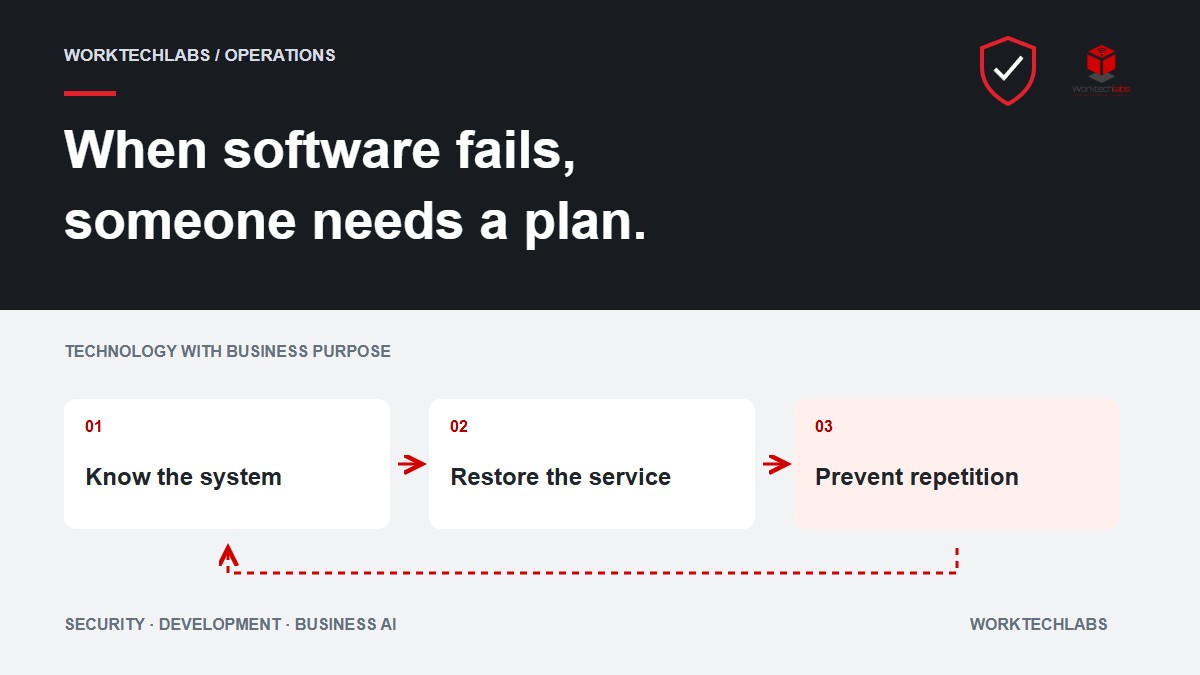
A response commitment says when somebody will acknowledge and begin handling an issue under the agreed conditions. It does not automatically promise a complete repair within the same period. Restoring service through a safe workaround can also be different from removing the underlying defect.
Ask a proposed supplier to explain those stages using a realistic example. If order submission fails, they might first confirm the impact, then enable an agreed manual route, and later deploy a tested correction. Each stage should have a responsible person and an understandable status update.
Agree how severity is determined. Use business impact, affected users and available alternatives rather than the volume of urgent messages. A cosmetic error visible to everybody may matter less than a hidden failure preventing a small dispatch team from completing the day's work. Give staff examples so reporting is consistent.
Check the coverage behind the promise
Support hours should match the business process. Discuss what happens at the end of the working day, during holidays and when the main contact is unavailable. If the service includes out-of-hours coverage, clarify the staffing and escalation arrangements actually included in the agreement.
Ask which work a support engineer can perform without waiting for another approval. Restarting a component, changing a configuration, replaying a transaction and restoring a database have different consequences. Prepare the decision boundaries before an incident so urgency does not become a substitute for authority.
Microsoft's incident-management guidance emphasises defined roles, escalation procedures and preparation for working with external support providers. It also recommends rehearsing the plan. These are useful foundations for a supplier discussion rather than guarantees about any specific contract. See the Azure Well-Architected incident-response guidance.
Make onboarding produce operational knowledge
A support handover should include more than a repository link and a list of passwords. The incoming team needs to understand how the application is built, deployed, monitored and recovered. It needs appropriate access, a dependency map and a way to reproduce the important behaviour.
Use a small practical exercise to verify the handover. Ask the team to locate a failed background operation in a nonproduction environment, explain its impact and follow the documented recovery procedure. The exercise can reveal missing access or unclear instructions before a customer incident exposes them.
For inherited software, allow time for investigation. A supplier cannot responsibly promise detailed knowledge of an undocumented system immediately after receiving its source code. Agree an initial review and prioritise the gaps that affect response most: deployment ownership, data recovery, unavailable diagnostics and unsupported components.
Measure whether the support service is improving
A monthly report should help your company make decisions. Useful questions include how quickly significant issues were detected, how service was restored, which problems recurred and which corrective actions remain open. Read the numbers in context: a complicated recovery may deserve more attention than several quickly closed minor tickets.
Track the work customers and staff cannot see in a simple incident count. A colleague manually repairing data every morning may be masking an integration failure. Repeatedly asking users to clear a cache may conceal a defect that deserves a permanent correction. Support should make recurring friction visible enough to prioritise.
Assign an owner and an outcome to each agreed improvement. “Improve monitoring” is difficult to close objectively. “Detect an unprocessed order and notify the duty engineer with its reference” describes something the team can demonstrate. Close the action when that behaviour has been verified.
Connect support to safe change
Support teams often understand the patterns that make releases risky: a particular supplier interface, a fragile import or a report used at month end. Feed that knowledge into planning and testing. An incident review should influence the next delivery rather than disappear into an archive.
Reserve capacity for maintenance that prevents avoidable problems. That can include supported platform updates, expired documentation, access reviews and recovery exercises. Decide how this work is prioritised against feature requests so it is not repeatedly postponed until an emergency creates the budget.
Keep business approval separate from technical execution when consequences require it. A support engineer may identify a way to repair records, but the company still needs to confirm the intended business result. Record the proposed change and its validation so the next person can understand what happened.
How Worktechlabs approaches the conversation
Our support and managed service covers defined arrangements for monitoring, maintenance and continuing development, with the actual scope agreed for the system. We can assess applications we built and software inherited from another supplier. The starting point is understanding the service and the evidence available to operate it.
Bring your critical workflows, recent incidents, current supplier responsibilities and any existing handover material. A focused review can identify what a support agreement should cover and what preparation is needed before it begins. If you already have an operational issue, use the support contact route and describe the business impact so the conversation starts with the work that is blocked.
Official guidance checked on 7 October 2026. Coverage, response commitments and included work depend on the agreed support arrangement.