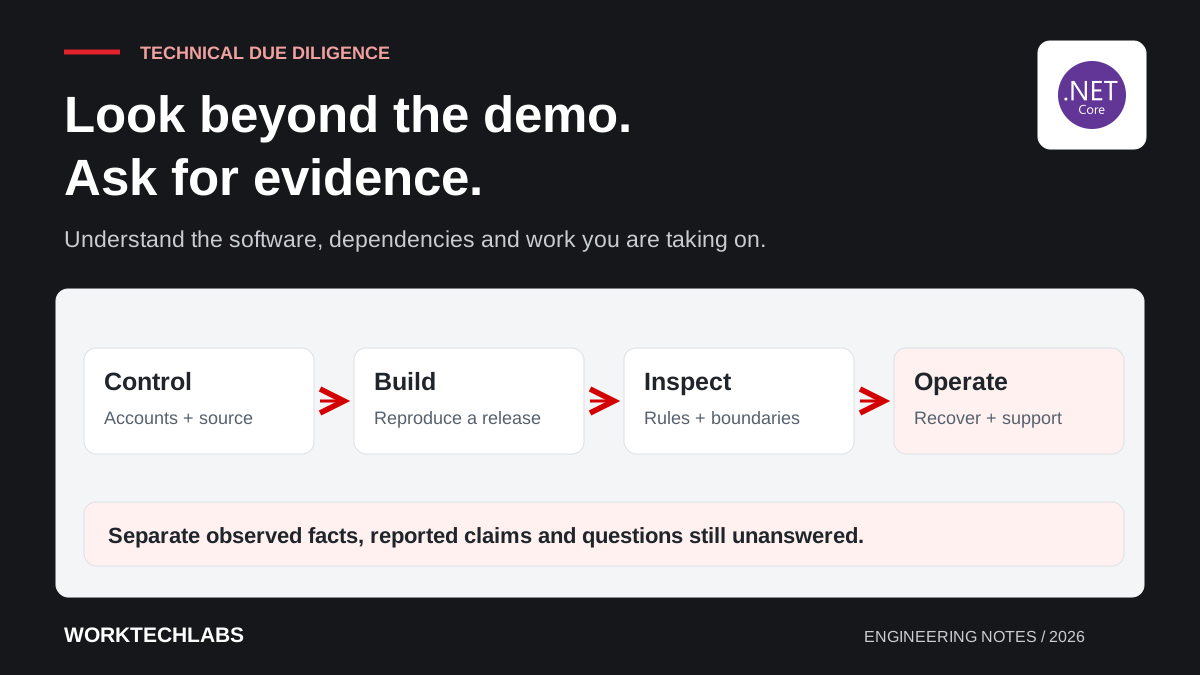
A polished demonstration shows that a product can perform selected tasks. It does not show whether another team can build it, release it, recover its data or change its most important rules. Those questions matter when a business takes over an application, changes development suppliers or commits to extending an existing platform.
Technical due diligence turns those unknowns into a practical picture of the software and the work ahead. The assessment should produce evidence, explain its limits and connect findings to business consequences. A list of fashionable technologies or a single code-quality score is not enough to support a decision about an application the business expects to depend on.
Agree which decision the review will support
Define the purpose before inspecting the repository. A supplier handover, a planned product expansion and the acquisition of a software asset raise overlapping but different questions. Identify the intended operating model, the capabilities the business needs and any near-term commitments that the software must support.
Set the review boundary explicitly. Record which applications, environments and integrations are included, what access is available and which evidence must be supplied by others. An assessor should distinguish what they observed directly from what someone reported or what remains unverified.
Choose the most consequential workflows for deeper inspection. In a hypothetical scheduling product, booking availability and customer data separation may matter more than a rarely used administration screen. Sampling should follow business risk rather than whichever part of the codebase is easiest to read.
Establish what the business actually controls
Create an inventory of repositories, hosting accounts, domains, deployment identities, external services and essential tools. Record who administers each asset and how access is transferred or recovered. A functioning application can still be difficult to operate if key accounts belong only to a departed contractor.
Identify third-party components and the information available about their licences, support arrangements and renewal responsibilities. The technical review should surface missing records and dependencies for the appropriate business owners to assess. It should not turn an unverified ownership assumption into a statement of certainty.
Check whether source code corresponds to the deployed product. Record the production version and trace it to a repository revision and build artefact where possible. If nobody can make that connection, future changes begin from an uncertain baseline even when the source repository appears complete.
Prove the build and release process
Ask someone outside the original development team to build the application using the supplied instructions. Note missing SDKs, private package feeds, undocumented settings and manual steps. This exercise reveals whether the documentation is sufficient to create a working development environment.
Then inspect how an approved version reaches production. Identify which checks run, who can deploy and how the previous version is located during recovery. A screenshot of a successful pipeline is useful evidence, but it does not establish whether that pipeline is the one currently used for releases.
For a higher-confidence review, observe a controlled release to a suitable environment. Verify the resulting version and an important user journey. Keep the exercise within the agreed scope; the purpose is to establish reproducibility without introducing an unnecessary change to live business operations.
Inspect the boundaries that govern change
Review how business rules, data access and external integrations are organised. Look for dependencies that make routine changes spread across unrelated areas. A simple architecture can be maintainable, while a complex architecture can still contain tightly coupled rules that force every component to change together.
Use a representative change as a discussion tool. For example, ask how the system would add a new approval level or integrate a different supplier. Follow the affected code, tests, configuration and deployment steps. The answer provides more useful evidence than an abstract debate about whether the project uses the preferred architectural pattern.
Identify concentration of knowledge. If only one engineer understands pricing, imports or recovery, record the resulting dependency and the work needed to reduce it. Clear interfaces and examples can make knowledge transferable; a large collection of comments does not necessarily achieve that outcome.
Examine security practices through concrete evidence
Inspect authentication, authorisation and the handling of credentials around the selected workflows. Verify that access checks happen on the server and that users cannot gain access merely by changing a record identifier. Review how the team updates dependencies and responds when a vulnerability is identified.
NIST's Secure Software Development Framework provides a useful reference for discussing development practices and vulnerability response. Using it as a review aid does not mean that a brief assessment certifies the product or proves the absence of vulnerabilities.
Request examples of the process in use: an access-control test, a recent dependency update and a documented response to a relevant finding. Evidence of repeatable practice is more informative than a policy document that has never influenced a release. Record where further specialist testing is needed instead of implying that a code sample settles every security question.
Check operations, data and recovery
Inspect how the application is monitored and supported. Determine whether an operator can identify the deployed version, follow a failed transaction and distinguish an application problem from an unavailable dependency. Review recurring incidents and unresolved support problems for patterns that a clean demonstration may hide.
Examine data ownership, backup arrangements and the evidence from restoration exercises. A backup configuration describes intent; a successful restore and business validation demonstrate a capability. Note the recovery objectives and whether measured results support them.
Evaluate current demand and plausible growth against the known architecture. Use workload evidence rather than assuming that a particular cloud service guarantees scalability. Identify expensive or difficult constraints, such as a large synchronous report, uncontrolled tenant contention or a supplier integration with a restrictive request limit.
Separate urgent risks from ordinary improvement work
Classify each finding by consequence, evidence and the circumstances that make it relevant. Distinguish an immediate exposure from a maintainability concern and an optional preference. This helps the business avoid treating every observation as equally urgent or dismissing an important risk inside a long list of minor issues.
For each material finding, describe a next action and the uncertainty around it. Some actions are straightforward, such as documenting a missing deployment input. Others require investigation before a responsible estimate can be made. State the assumptions behind any proposed remediation sequence.
End with a practical handover or improvement plan, not just a report. Worktechlabs provides independent code and architecture reviews that connect technical findings to delivery and support decisions. The companion software handover guide explains how to turn that evidence into a transfer the receiving team can demonstrate.