
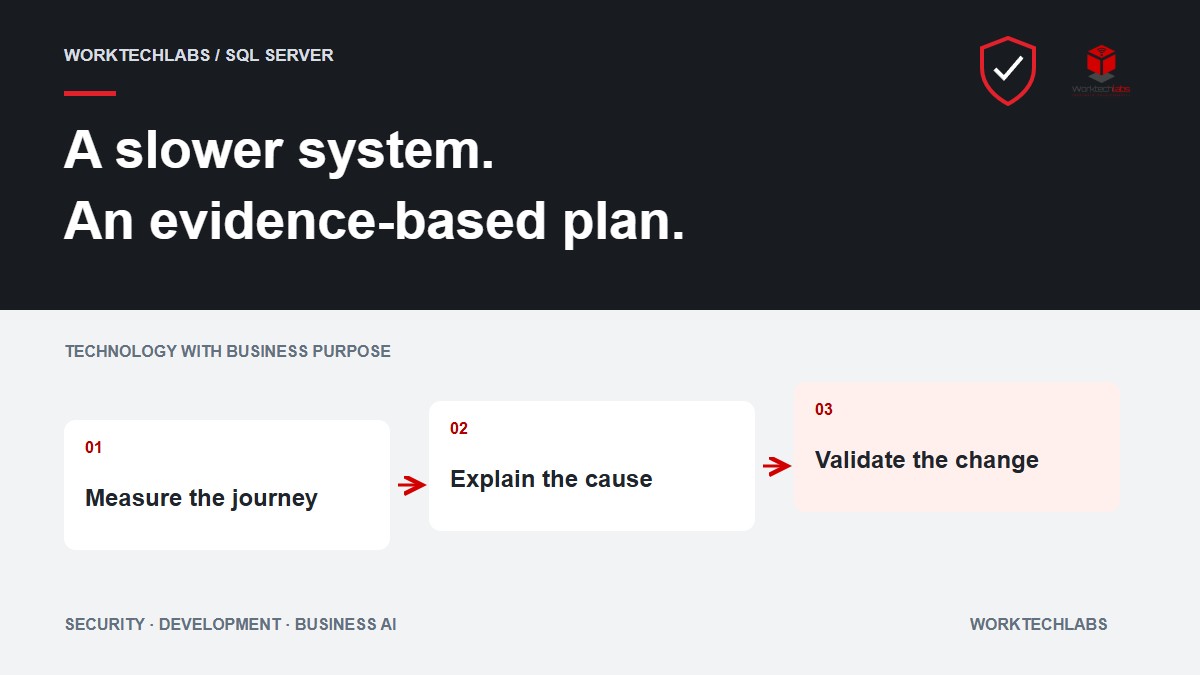
A SQL Server performance audit should leave your business with an explanation of the slowdown, evidence supporting that explanation and a prioritised plan for improvement. A collection of screenshots or a recommendation to buy a larger server is not, by itself, enough to make an investment decision.
For a UK business relying on an ERP, customer portal or operational application, the useful question is what staff and customers will experience differently. Will orders save reliably at busy times? Can the finance team finish its reporting? Can the next release proceed with an understood risk? Define those outcomes before commissioning the review so the scope and deliverables are clear.
When should a business request a performance review?
Consider a review when a recurring delay affects meaningful work: order entry repeatedly times out, a report blocks other users, a batch job overruns into office hours or cloud spend rises without a corresponding explanation. A slowdown after a release or a sharp increase in data volume also gives the investigation a useful starting point.
Ask for help before an important change if the current system has little performance evidence. An acquisition, new customer portal or additional branch can alter the workload. A baseline review can identify uncertainty and propose tests before the company promises a level of service it has not demonstrated. This is different from guaranteeing future capacity from a short inspection.
An active service outage needs incident handling first. Agree whether the engagement is emergency restoration, a planned audit or both, and who authorises production changes. A review scheduled for next week is not an operational response to staff being unable to complete essential transactions today.
What information should you provide?
Prepare a short account of the affected journeys, including timestamps, approximate user numbers, examples of slow and normal behaviour and recent releases. Record time zones when systems differ. “Saving an order at 09:15 London time takes much longer than at 14:00” is more useful than “the database is sometimes slow”.
Provide an inventory of the application, database version and hosting arrangement, plus a simple map of connected services. Identify scheduled imports, exports and maintenance tasks. Share known constraints such as supplier access, permitted change windows and the availability of a representative test environment. These details help the reviewer plan the evidence collection instead of spending the engagement discovering basic ownership.
Agree access and data handling before collection starts. Use permissions appropriate to the diagnostic tasks, identify who approves additional access and decide where results will be stored. Query text and sample parameters can reveal business information. The reviewer should explain what is needed, what can be redacted and how diagnostic material will be handed over or removed afterwards.
Deliverable one: a baseline linked to user experience
Expect the report to define the observation period, workload and measurement points. It should connect user-visible delay with application calls and database activity where the available evidence allows. Record normal variation and busy periods. A single fast test after hours cannot establish that a problem affecting concurrent users has been resolved.
The baseline should include relevant durations, execution frequency, resource use and error or timeout rates. Ask for the distinction between average behaviour and the slower requests that users actually complain about. Also record the output's correctness: an apparently faster report that omits required records does not meet the same requirement.
Microsoft documents Query Store as a source of query, plan and runtime history. Ask whether it was available, appropriately configured and retained for the incident period. If the necessary history is missing, the report should state the limitation and propose a collection window rather than invent a retrospective diagnosis.
Deliverable two: findings with evidence and confidence
Each finding should identify an affected journey, the observed symptom, the supporting evidence and the likely cause. Distinguish a confirmed bottleneck from a hypothesis needing further investigation. For example, seeing a report and order delays at the same time is a lead; showing the relevant blocking chain is stronger evidence of their relationship.
Expect the reviewer to consider both database and application behaviour. Repeated calls, oversized responses or waiting on an external service can produce a slow screen even when individual database queries are fast. The agreed scope may not include fixing all those layers, but the report should make the boundary visible rather than attribute every delay to SQL Server.
Microsoft's slow-query troubleshooting guidance distinguishes active execution from waiting on a bottleneck. A business-facing finding should translate that distinction into an understandable explanation. You should be able to see why the proposed action addresses the evidence and what remains uncertain.
Deliverable three: a prioritised improvement plan
Ask for a plan ordered by business impact, effort, risk and dependencies. Each action needs an owner, an expected outcome and a validation method. Separate work included in the audit from implementation requiring another approval. “Optimise indexes” is too broad to budget without identifying the affected workload and the change to be tested.
The plan might include a query change, a more focused result set, a shorter transaction, an adjusted background schedule or a capacity increase. There is no universal sequence that makes one action correct for every system. Ask the reviewer to explain alternatives, including temporary mitigation when a permanent application change will take longer.
Require rollback conditions for production changes. State what is monitored, who makes the decision and how the previous behaviour can be restored. Where a change affects data rather than only configuration, ask how new transactions will be preserved. A rollback plan should fit the actual change, not consist of a generic promise to restore a backup.
Deliverable four: validation and an operational handover
An audit may diagnose and recommend without implementing changes. If implementation is included, expect before-and-after results using comparable workloads and representative parameters. Include neighbouring workflows: an improvement to reporting may affect writes, and a faster cached response may have different freshness. Document those trade-offs so acceptance is based on the complete business result.
For an illustrative example, suppose staff report slow order saving during a morning import. The handover should explain what evidence linked the two, what adjustment was tested and how the team will compare the next import period. Any measured improvement belongs to that workload; it should not become a promise that every screen is faster by the same percentage.
Ask for readable findings, technical evidence, reproducible checks and a monitoring recommendation. Agree a follow-up window and the route for a regression. Your internal team or another support provider should be able to understand what changed and why without reconstructing the investigation from a specialist's memory.
Questions to ask before accepting a quote
Confirm the databases and applications included, observation duration, access requirements and expected meetings. Ask whether the price includes a written report, a findings discussion, a change plan and any implementation or follow-up. Clarify treatment of unavailable access, missing historical data and extra systems discovered during the review.
Agree who will receive the business summary and who needs the technical evidence. Ask for a redacted example of the proposed report structure, rather than requiring a supplier to share another customer's confidential findings. This helps distinguish a repeatable assessment process from a loosely defined block of consultancy time.
Worktechlabs can review .NET and SQL Server applications and help prioritise remediation through an independent technical assessment. Our guide to investigating SQL Server performance explains the underlying approach. Request a project discussion with a specific slow journey, recent examples and the business deadline the review needs to support.
Official sources and further reading