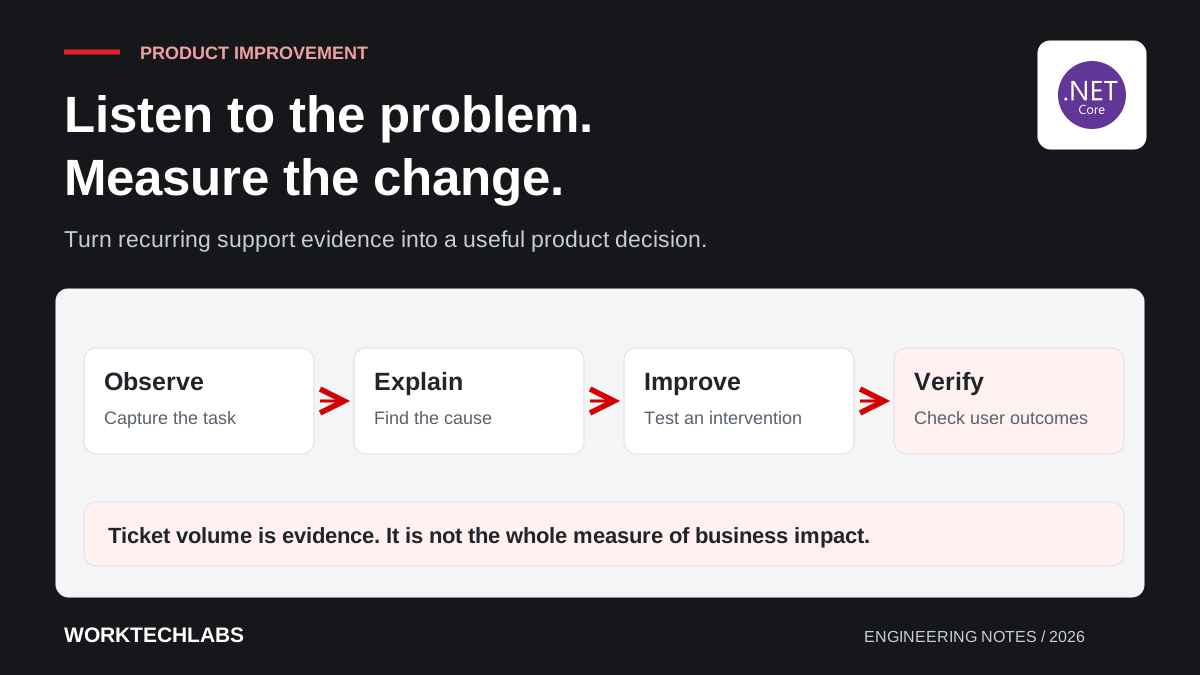
Support requests contain evidence about where a product fails to match people's work. They also contain noise: duplicate reports, incomplete descriptions and proposed solutions that do not explain the underlying problem. A useful product roadmap comes from interpreting that evidence, not simply promoting the most frequent ticket title into the next feature.
The aim is to connect recurring difficulties to a specific user journey, understand their consequences and choose an intervention that can be evaluated. Sometimes the right response is a feature. Sometimes it is clearer wording, better training, improved data or a technical fix that prevents the problem from reaching users at all.
Capture the task behind the request
When a user reports a problem, record what they were trying to accomplish and what prevented completion. Include the relevant context, such as their role, the stage of the workflow and the result they expected. “Add a bulk button” describes a proposed solution; “I repeat the same update for fifty jobs every morning” describes work worth investigating.
Preserve the user's explanation without requiring support staff to write a long research report. A few consistent fields can make later analysis much easier. Avoid capturing unnecessary personal information when an anonymised workflow description will answer the product question.
Keep the immediate support response separate from the product investigation. The person still needs help completing today's task. Resolving that request and investigating why the same difficulty keeps occurring are related responsibilities, but they can have different owners and timescales.
Group by cause and journey, not just wording
Several differently worded tickets may describe the same obstacle. Conversely, several tickets titled “login problem” may have unrelated causes. Group reports using the affected journey and the best available explanation, while keeping uncertainty visible where investigation is incomplete.
Distinguish a defect, a usability difficulty, a missing capability and a data problem. These categories suggest different interventions. They also prevent a backlog from becoming a collection of requested screen changes when the underlying issue belongs elsewhere.
For a hypothetical booking application, reports about disappearing appointments could reflect failed saves, timezone confusion or filters that hide completed work. Treating all three as one feature request would make it difficult to determine whether any subsequent change solved the problem.
Consider the people who never submit a ticket
Ticket volume is an incomplete measure of impact. Some users repeatedly ask for help, while others abandon the workflow, create a spreadsheet workaround or stop using the product. A low number of reports does not prove that a journey works well.
Combine support evidence with appropriate usage data, interviews and observation. Investigate whether affected users complete the task, return later or require help from colleagues. Keep the measures close to the business outcome rather than counting visits to a page that may be visited because it is confusing.
The GOV.UK guidance on measuring user satisfaction offers useful ideas about collecting feedback alongside service evaluation. For a commercial product, adapt the approach to its users and decisions instead of assuming a single survey score explains the experience.
Prioritise consequences and repeated effort
Assess how the issue affects completed work, staff time and confidence in the product. A rare failure that prevents a critical transaction may deserve more attention than a frequent inconvenience. Record the evidence supporting that judgement so prioritisation does not depend entirely on the loudest voice in a meeting.
Estimate repeated manual effort with the people performing it. If a support specialist corrects the same type of record each week, investigate both the correction time and the disruption to users. This can reveal a worthwhile improvement that is invisible in a feature-request count.
Include uncertainty in the prioritisation. An issue with substantial potential impact but little evidence may need a short investigation before implementation. Treating discovery as an explicit next step is often better than assigning a large development estimate to an unclear problem.
Choose the smallest intervention that tests the explanation
Write a hypothesis connecting the proposed change to the observed difficulty. For example, clearer status information may reduce repeated submissions because users can see that their request is still processing. The hypothesis gives the team something to check after release.
Compare possible interventions. A missing field explanation might be solved through wording and validation rather than a new help centre. Repeated data corrections might be prevented at entry rather than automated after the fact. A feature is one possible tool, not the default answer to every support pattern.
Keep acceptance examples tied to the original reports. Include the circumstances that caused difficulty and the result the user should now achieve. These examples help the delivery team preserve the purpose of the change as implementation decisions become more detailed.
Close the loop after release
Define what evidence will indicate improvement before the change goes live. Relevant measures might include successful task completion, fewer repeated submissions or less time spent on a known manual correction. Use the same definitions before and after so the comparison remains meaningful.
Tell support staff what changed and how to recognise related reports. Otherwise, they may continue using an obsolete workaround or categorise a new problem under the old explanation. Provide a short, practical note rather than expecting them to infer behaviour from a developer-oriented release log.
Review whether the intervention introduced new friction. A validation rule may prevent incorrect records while confusing users who previously entered legitimate exceptional cases. Improvement should be assessed across the journey, including the exceptions that motivated support requests in the first place.
Give the feedback process an owner
Establish a regular review where support and product owners examine a small number of patterns and make decisions. Each selected issue should have an owner and a next action: investigate, improve, monitor or explain why it is not currently being addressed. Avoid collecting feedback indefinitely without showing how it influences the product.
Keep the evidence accessible in the development backlog. Link the proposed change to representative reports, observations and acceptance examples. This helps future engineers understand why the feature exists and prevents the same issue being rediscovered when team members change.
Do not promise every requested feature. A clear explanation of the problem being addressed and the current decision is more useful than a long list of vague commitments. The process should help the business choose deliberately while treating users' experiences as evidence worth understanding.
Worktechlabs combines ongoing support with custom application development so recurring problems can inform maintainable improvements. A productive roadmap connects what people struggle to do today with a change whose effect can be observed after it reaches them.