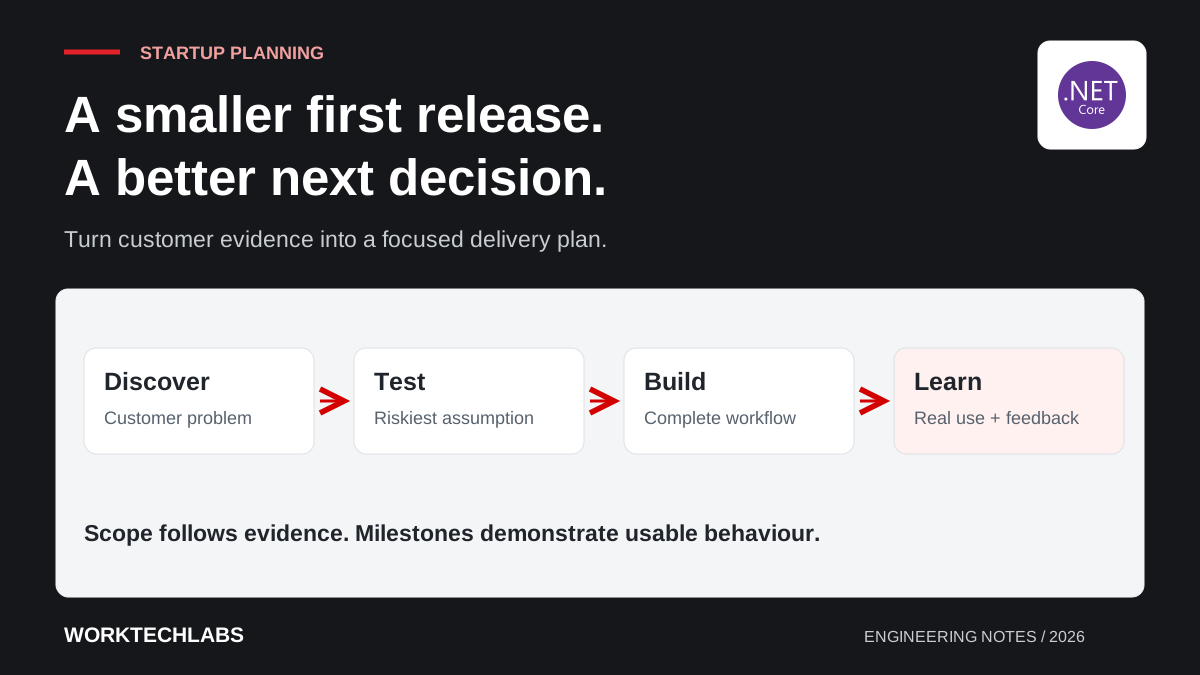
A startup software plan should help the team decide what to learn and deliver next. It cannot remove uncertainty about customers, demand or the product itself. A detailed schedule built on untested assumptions can look reassuring while committing the business to the wrong work.
The strongest early plan connects a customer problem to a small, complete workflow and a way to observe whether that workflow is useful. It also accounts for the practical work around the software: access, data, support, ownership and the ability to release changes. Those decisions make a first version usable rather than merely demonstrable.
Describe the customer problem in operational terms
Start with a particular user doing a particular task. Record what triggers the task, how they handle it now, where time or information is lost and what a better outcome would look like. “A platform for small businesses” is too broad to guide implementation. “A way for independent service teams to turn an accepted quote into scheduled work” gives the team something to investigate.
Interview people who perform the task and, where possible, observe the current process. Separate what they report from what you infer. A customer asking for a dashboard may actually need confidence that no job has been forgotten. Understanding that need can change the first feature substantially.
Keep a short evidence log. Record the source of an observation, the assumption it supports and what remains uncertain. The GOV.UK guidance on discovery is written for public services, but its emphasis on understanding users and constraints is also useful when planning a startup product. Applying that principle does not require copying an entire government delivery process.
Rank assumptions by consequence and uncertainty
Not every open question deserves the same attention. List the assumptions that could invalidate the plan: whether customers will adopt the workflow, whether a required integration is available, whether the data can be accessed and whether the team can deliver within its capacity.
For each assumption, choose a small investigation that can change a decision. A clickable prototype may test whether users understand the workflow. A technical spike may establish whether an external API exposes the required information. A manual pilot may show whether the proposed service solves a problem before software automates it.
Define the decision in advance. For example, if the integration cannot supply timely stock information, the product may need a different promise to customers. An experiment without a decision attached can become an interesting demonstration that leaves the original plan unchanged regardless of what it reveals.
Choose a complete first workflow
An MVP should be small enough to deliver and complete enough to learn from. It is usually more useful to support one customer journey end to end than to build an impressive collection of disconnected screens. Include the exception states that make the journey usable: cancellation, validation errors, missing information and a route to support.
For a hypothetical field-service startup, the first release might allow a team to create a quote, get it accepted, schedule the job and record completion. Advanced forecasting and a broad marketplace could wait. This example illustrates scope selection; it is not a universal feature list or a delivery estimate.
Write down what is deliberately outside the first release and why. This protects the team when a reasonable idea arrives during implementation. New ideas should enter a visible decision process rather than being quietly added to the current commitment.
Turn requirements into examples people can review
A requirement such as “support permissions” hides many decisions. A concrete example is easier to evaluate: a field worker can see assigned jobs but cannot edit another team's pricing. Another example might state that an accepted quote cannot be changed without creating a recorded revision.
Use these examples to define acceptance criteria with the people responsible for the business process. Include ordinary cases and the few exceptions that matter most. Engineers can then choose appropriate automated checks, while stakeholders can review the behaviour without needing to read the implementation.
Clarify who can accept a feature and how quickly questions will be answered. A small team loses momentum when developers wait days for decisions from several founders who disagree. Name a product decision owner and keep a record of significant choices so the same issue does not restart every week.
Plan capacity and scope together
An estimate should state its assumptions, dependencies and level of uncertainty. Early in a project, a range is often more honest than a precise date. As the team completes representative work and resolves unknowns, it can update the forecast with better evidence.
Account for the work outside feature coding: design, review, testing, environments, deployment, data preparation and stakeholder feedback. Include the availability of founders and subject specialists. A plan that assumes immediate answers from a busy business owner is making a capacity assumption just as real as the number of developers assigned.
Use milestones that demonstrate progress. “Customers can complete the first booking in a test environment” is easier to assess than “backend phase complete”. A useful milestone produces something reviewable and exposes the next uncertainty rather than deferring all integration to the end.
Make architecture serve the first product
Choose technology the team can operate and change confidently. A simple deployment model with clear internal boundaries can support substantial growth. More services and infrastructure introduce coordination work, so add them when requirements justify the cost.
Record a few decisions that are expensive to reverse: customer data separation, identity, the ownership of important records and key external contracts. Other decisions can remain deliberately flexible. The aim is to distinguish genuine constraints from preferences that can change after the team learns more.
Our comparison of modular monoliths and microservices explores this trade-off. For many early products, disciplined boundaries and a reliable release process provide more immediate value than designing for an organisation much larger than the current one.
Prepare to operate the first release
Decide who owns the cloud account, source repository, domain, credentials and deployment process. These should be accessible to the business through appropriate roles and documented arrangements. A product should not depend on a single contractor's personal account to remain available.
Define support expectations and the information needed to investigate problems. Add monitoring for the main workflow, verify backup and recovery arrangements, and provide a way to correct or escalate failed transactions. The first paying user will experience these details as part of the product, regardless of whether they appeared in the original feature list.
Budget for iteration after launch. Customer feedback will reveal misunderstandings and opportunities that planning could not settle. If every available resource is spent reaching the launch date, the team may have no capacity to respond when the most valuable evidence finally arrives.
Review the plan as evidence changes
Hold a regular review of delivered behaviour, customer feedback, spending and unresolved assumptions. Keep the discussion focused on decisions: continue, change the scope, investigate further or stop a particular idea. Avoid equating completed tasks with proof that the product is useful.
Agree a small set of outcome measures relevant to the first workflow. These might include successful completion, repeated use, time saved or the number of cases requiring manual help. Define how the information will be collected before launch so the team is not relying only on enthusiastic anecdotes.
Worktechlabs can help turn an early idea into a focused project brief, a delivery plan and a first application. The plan should give founders a clear view of what they are buying, what remains uncertain and which result will inform the next decision.
Related service: .NET and Azure development.